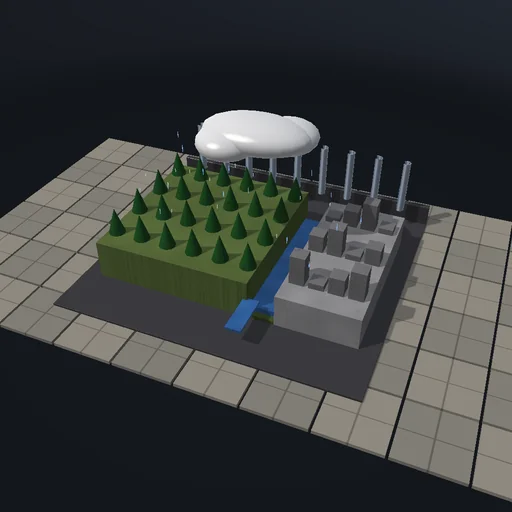
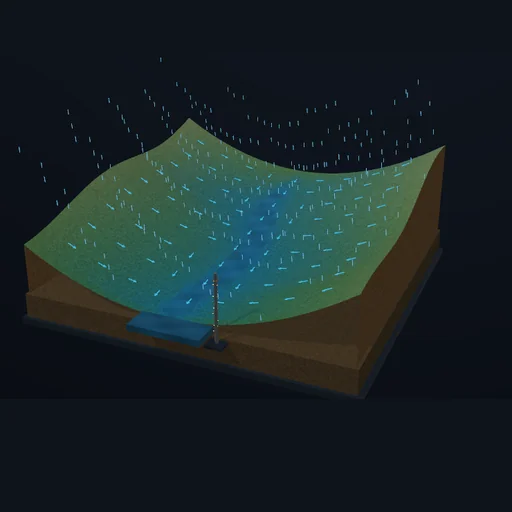
Earth
Glacial rebound
Grow a 1000 km wide, 2 km thick ice sheet over ten thousand years, hold it, melt it in five and watch the land answer: the lithosphere bends as a 50 km elastic plate towards Hetenyi’s bowl, 556 m deep at the centre with a 19 m forebulge 250 km beyond the ice edge, each wavelength of the depression relaxing through the mantle at its own time, three thousand years for the longest. After the melt the centre is still 240 m down and rising at 60 m per thousand years. Thicken the plate and the bowl widens and shallows; double the viscosity and everything takes twice as long; melt gradually and the land never gets far behind the ice.
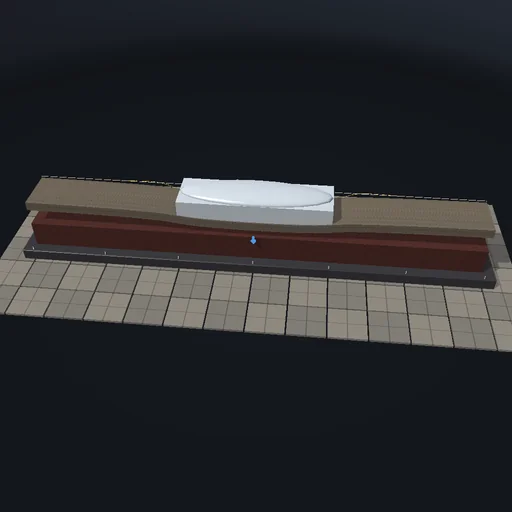
What happens
An elastic lithosphere on a viscous mantle half-space under a box ice load that grows, holds and melts: the deflection is a cosine series of 256 modes on a 4000 km periodic domain, each mode with the equilibrium −q_n/(ρ_m·g + D·k⁴) and the half-space relaxation time 2η·k/(ρ_m·g + D·k⁴), stepped by exact exponentials with the load held over each sub-step. The equilibrium under the full load is Hetenyi’s plate under a box load, the difference of two semi-infinite loads, which gives the forebulge beyond the ice edge; the uniform mode settles at once. One second of the experiment is one thousand years.
Try this
Watch the bowl form under the ice and the forebulge rise beyond it, then the land rebound after the melt; thicken or thin the plate, double the viscosity, melt gradually and compare.
The model and its limits
A uniform elastic plate on a uniform viscous half-space, a box load without ice flow or sea-level feedback, periodic boundaries at 4000 km. Rates are those of this one-layer mantle.
Equations used in the module
Equations
D = E·T_e³/12(1 − ν²),  α = (4D/ρ_m·g)^(1/4)
w_n^eq = −q_n/(ρ_m·g + D·k_n⁴),  τ_n = 2η·k_n/(ρ_m·g + D·k_n⁴)
w_n(t + Δt) = w_n^eq + (w_n − w_n^eq)·e^(−Δt/τ_n)
w_box(x) = w_semi(x − a) − w_semi(x + a),  w_semi(ξ<0) = (q/k)·(1 − ½e^(ξ/α)·cos(ξ/α))