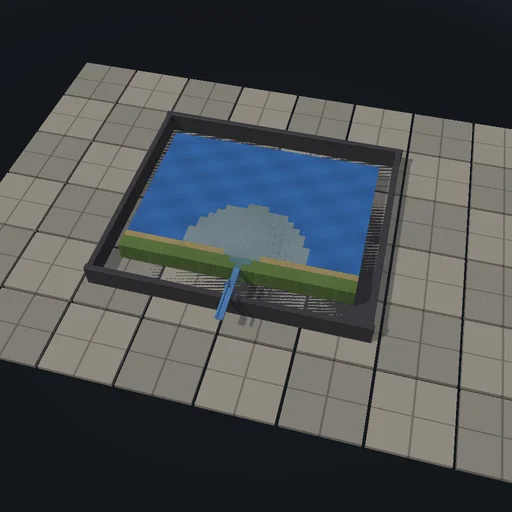
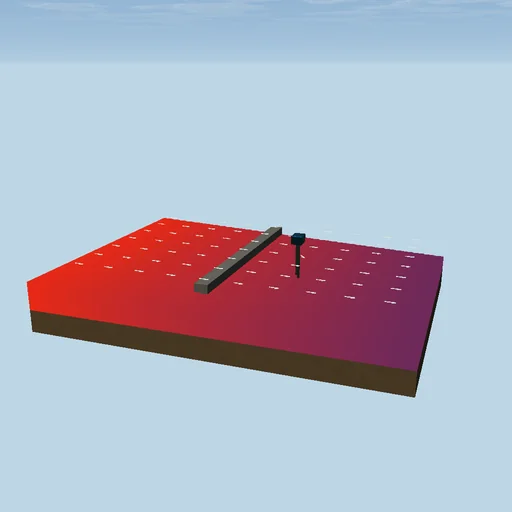
Earth
River meanders
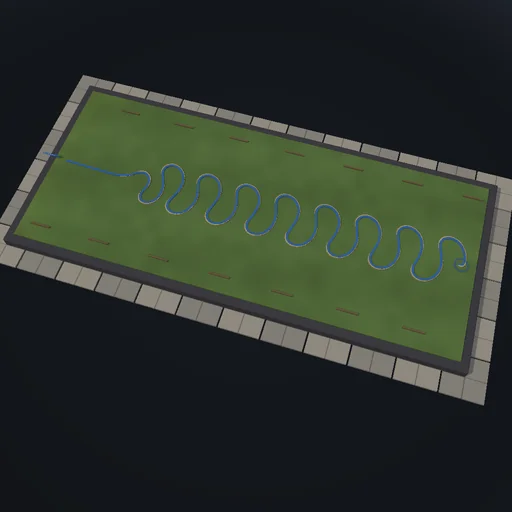
Let a 20 m wide river with a two-metre wiggle run for two thousand years: the near-bank flow feels the curvature a little upstream of where it is, so the outer bank of every bend erodes while the inner bank builds a point bar with the same volume, bends 400 m long grow fastest, the closed-form wavelength of the bank law, and the channel’s sinuosity climbs past two until necks are cut and oxbows left. A dead-straight channel never moves; double the erodibility and the first centuries move twice as fast; the circumcircle curvature of a test arc is exactly 1/R.
What happens
The channel centreline is a polyline of 20 m points whose curvature comes from the circumcircle of each three; the near-bank velocity follows Howard and Knutson, a negative local weight on the curvature plus a positive upstream-weighted curvature with a 50 m exponential lag, so bends shorter than the lag decay and the longer ones grow fastest at a wavelength near twenty widths. The outer bank migrates at the erodibility times width times that velocity, the same volume lands on the inner bank, the polyline is remeshed each year, and when two distant points come within a width the neck is cut and the loop becomes an oxbow. One second of the experiment is one year.
Try this
Watch the wiggle grow into bends and the bends into loops until a neck is cut; try a straight channel, a doubled erodibility, a shorter lag, and read the fastest wavelength of the closed form.
The model and its limits
A kinematic bank law without flow, sediment or floodplain heterogeneity, fixed width and depth, a simple cutoff rule. Rates and shapes are those of this idealized channel.
Equations used in the module
Equations
C = 2·(b − a)×(c − b)/(|ab|·|bc|·|ca|)
u_b = Ω·C + Γ·∫C(s − ξ)·e^(−ξ/λ)·dξ/λ,  Ω = −1,  Γ = 2.5
v_n = E·B·u_b,  σ = E·B·k²·(Ω + Γ/(1 + k²λ²))
V_eroded = V_deposited,  S = L_channel/L_valley