Earth
Canyon erosion
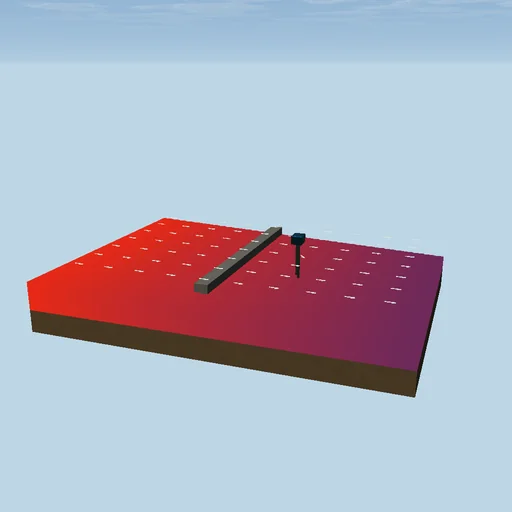
Lift a 100 km plateau at a tenth of a millimetre a year and let a river cut it: incision dz/dt = K A^0.5 S grows with the drainage area that Hack’s law collects downstream, so after thirty million years the profile settles on the closed-form S = U / (K A^0.5), steep near the divide and gentle at the mouth, with a canyon a dozen kilometres wide at 35 degree walls. Double the uplift and a knickpoint climbs upstream at the celerity K A^0.5, exactly where the travel-time quadrature puts it; lay a hard stratum in the stack and a waterfall stalls where the river meets it. Eroded volume meets uplift added minus the profile’s rise to rounding.
What happens
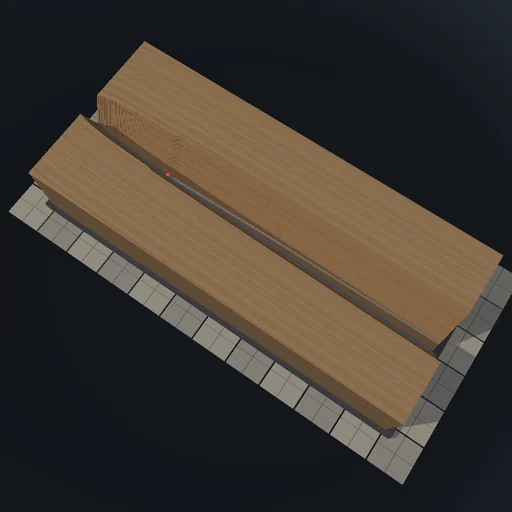
A river profile of 200 nodes at half a kilometre on an uplifting plateau: drainage area grows downstream by Hack’s law A = 10 + 2x^1.8 km², incision follows stream power dz/dt = U − K·A^0.5·S with the upwind slope and a fixed base level at the mouth, and an optional hard stratum between two elevations where K is a fifth. The steady profile is the closed form S = U/(K·A^0.5), a change of uplift sends a knickpoint upstream at the celerity K·A^0.5 whose travel time is the quadrature of 1/(K·A^0.5), the canyon’s width follows from its depth and the wall angle, and the eroded volume meets the uplift added minus the profile’s rise. One second of the experiment is one Myr.
Try this
Watch the profile settle on its steady shape and read the slope against U/(K A^0.5); double the uplift and follow the knickpoint upstream; switch the hard layer on and find the waterfall.
The model and its limits
Detachment-limited stream power with m = 0.5, n = 1, a prescribed area law, a plateau that erodes only through the river, a fixed base level. Rates are those of this profile model.
Equations used in the module
Equations
∂z/∂t = U − K·A^m·S,  A(x) = A_0 + c·x^h,  S = (z_i − z_(i+1))/Δx
S_steady = U/(K·A^m)
c_knick = K·A^m,  t = ∫dx/(K·A^m)
W = 2·(z_plateau − z)/tan θ,  V_eroded = U·t·L − Σ(z − z_0)·Δx