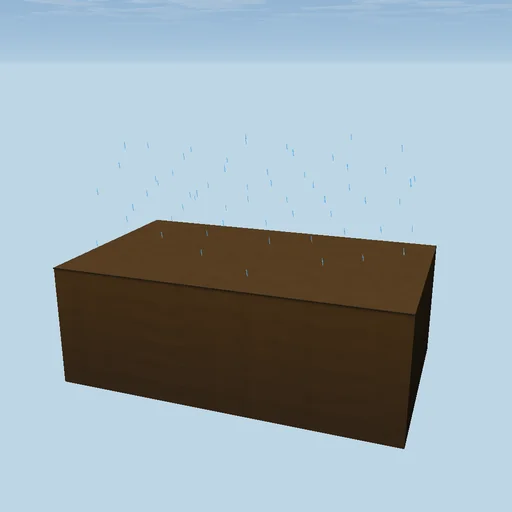
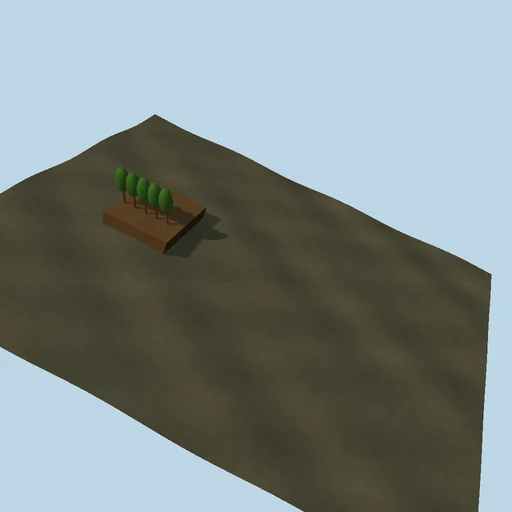
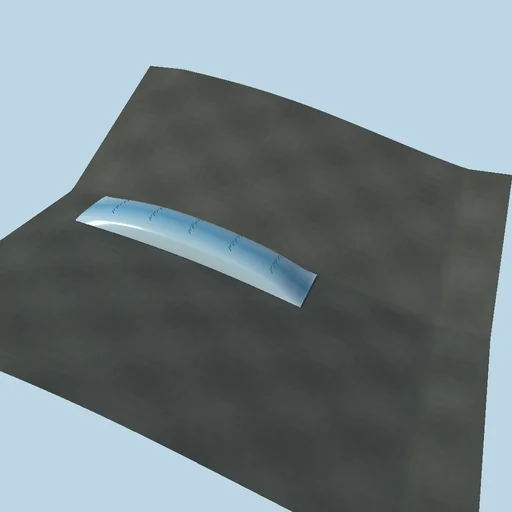
Earth
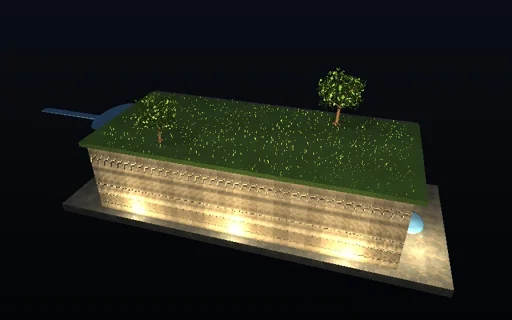
Water makes caves
Let a stream sink into a limestone hill through five hair-thin fractures and watch thirty thousand years go by: the water dissolves the walls fast near the entrance and, thanks to the slow fourth-order kinetics close to saturation, still a little all the way to the spring. Give one fracture twice the width and it takes two thirds of the flow, widens faster and breaks through in nine thousand years, until the stream cannot keep its pond full; leave them even and none breaks through. Feed half-saturated water and the caves grow half as fast, saturated water and not at all. The rock the walls lose is the calcium the spring carries away.
What happens
Five fractures, each 1000 m long, 1 m wide and a fifth of a millimetre open, between a sinking stream 20 m above a spring. The flow through a fracture is the cubic law of its forty cells in series; along it the water dissolves the walls with Dreybrodt’s kinetics: linear in the undersaturation (4·10⁻⁷ mol/m²·s) far from equilibrium, fourth order above 90 % saturation, integrated exactly cell by cell. Every mole the water carries away is the rock the walls lose, so they open by exactly that. When the conduits could swallow more than the stream’s 50 L/s, the pond above drains and the head falls. The step is limited to a tenth of the aperture per wall; one second of the experiment is one year at time scale 1.
Try this
Let thirty thousand years pass over even fractures, then give one twice the width and watch it break through; feed half-saturated water; check the balance of rock lost and calcium carried out.
The model and its limits
Parallel smooth fractures, laminar flow, calcite kinetics without CO2 exchange in the conduit, no collapse, no sediment; stalactites are decoration. Breakthrough times are those of this idealized network.
Equations used in the module
Equations
Q = ρ·g·ΔH/Σ(12μ·Δx/(W·a³))
F = k1·(1 − c/c_eq) below 0.9·c_eq,  F = k4·(1 − c/c_eq)^4 above
Q·dc/dx = 2W·F(c),  da/dt = 2F·V_m
rock lost = ∫Q·(c_out − c_in) dt