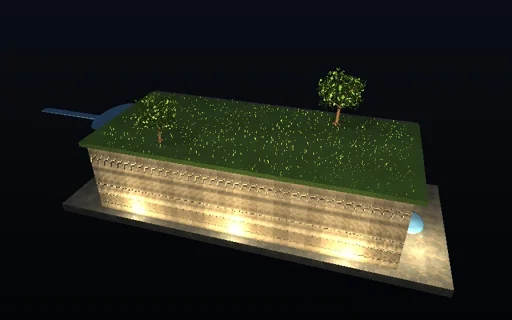
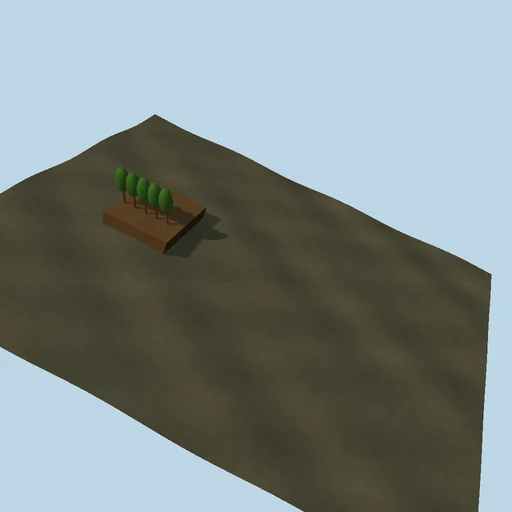
Earth
Confined aquifer
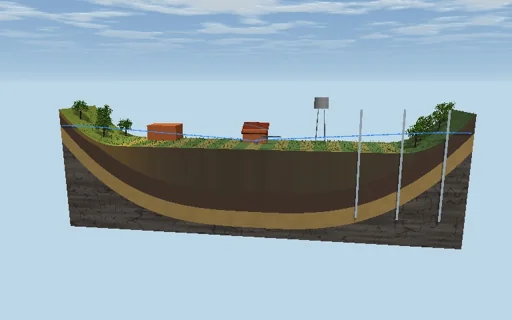
Drill a well into a sandstone fed from hills twenty kilometres away and see the head in it: shut the well and its gauge reads rho g times the height of the head above the wellhead; open it and it flows on its own, as long as the head stands above the wellhead - set the wellhead higher than the hills and it never flows. Pump it and the cone of depression spreads exactly as Theis’s well function says; leak water through the clay above and the drawdown settles at Hantush’s steady state with nearly all the water coming through the clay. Pump hard and then let the well flow again: weaker, because the aquifer has not refilled yet - the water is still there. Storage, leakage, the hills’ inflow and the well balance to rounding.
What happens
A confined sandstone of transmissivity 5·10⁻³ m²/s and storativity 10⁻⁴ around one well, on 120 rings from the 0.1 m bore to 20 km, where the hills hold the head at 60 m. The head obeys S dh/dt = (1/r) d/dr (T r dh/dr) + L (h_top − h), solved by backward Euler as a tridiagonal system in steps of 10 min, with an optional leaky confining layer under a water table at 40 m. The well is pumped at a set rate, or flows through its pipe at C (h − z_w) only while the head stands above the wellhead, or is shut and its gauge reads rho g (h − z_w). Storage, leakage, the hills’ inflow and the well balance to rounding; Theis, Cooper-Jacob and Hantush check the solver.
Try this
Shut the well and read the gauge; let it flow, raise the wellhead above the hills and it stops; pump and compare the drawdown with Theis; let the clay leak and compare with Hantush.
The model and its limits
A homogeneous, isotropic confined layer, radial symmetry, a fixed recharge head, a linearised well pipe; no compaction or density effects. Flows belong to this idealized basin.
Equations used in the module
Equations
S·∂h/∂t = (1/r)·∂/∂r(T·r·∂h/∂r) + L·(h_top − h)
s = Q/(4πT)·W(u),  u = r²·S/(4T·t);  s ≈ Q/(4πT)·(−γ − ln u)
s = Q/(2πT)·K0(r/B),  B = √(T/L)  (Hantush)
Q = C·(h − z_w) if h > z_w,  p = ρ·g·(h − z_w)