Physics / Astronomy
Radio telescope: aperture and pointing
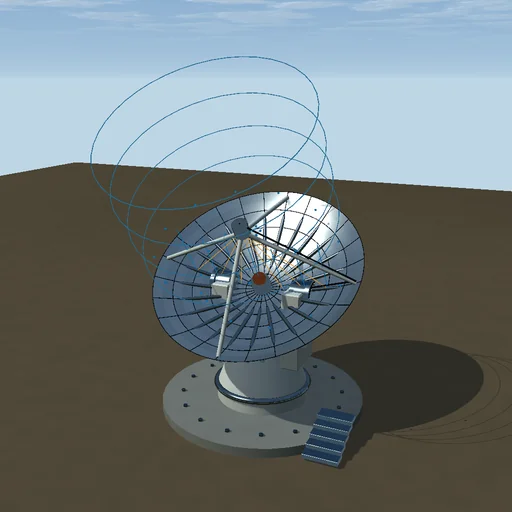
Inspect a primary-focus parabolic antenna and scan a point source through its main beam and sidelobes.
What happens
Scan a point source through a radio telescope's main beam and sidelobes. Compare a larger dish with a shorter observing wavelength.
Try this
The reference is a 12 m dish at 100 GHz. Compare aperture and wavelength, then change the pointing offset while the source crosses the beam.
The model and its limits
Single primary-focus dish, not an ALMA Cassegrain antenna or array. Uniform circular-aperture Airy pattern with 65% collecting efficiency. Rays obey specular reflection; the pointing angle uses the physical wavelength and diameter. No taper, blockage, receiver noise or interferometry.
Equations used in the module
Equations
I(θ)/I₀ = [2J₁(x)/x]²; x = πDθ/λ; FWHM = 1.028λ/D.