MakarovSuites
English
EnglishDeutschРусскийУкраїнськаFrançaisEspañolItalianoPolski
Contact & licences

Astronomy

The invisible halo around a galaxy

Build a Navarro–Frenk–White halo. Probe its enclosed mass, circular speed and light deflection at different galactic radii.
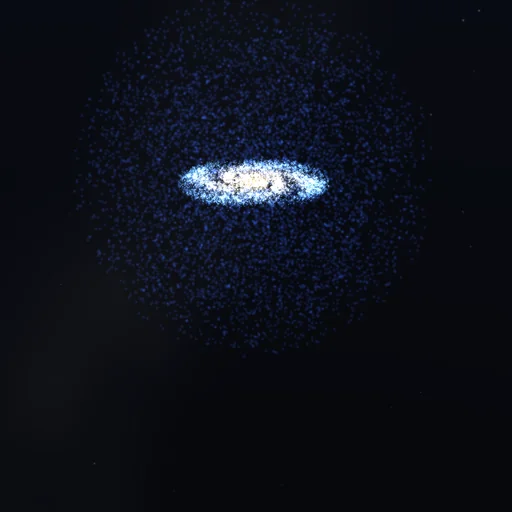
The invisible halo around a galaxy — Actual application image
Actual application image

The model and its limits

Spherical untruncated NFW halo with H₀ = 70 km/s/Mpc plus an exponential baryonic disk (scale length 3 kpc) whose enclosed mass is taken as if spherical. Coloured halo tracers represent inferred density, not luminous dark matter. Deflection is the halo’s thin-lens bending angle. Halo and probe radii use the same logarithmic distance mapping; the visible disk marks a 25 kpc radius.

Equations used in the module
Equations
ρ = ρ_s/[x(1+x)²]; M = 4πρ_s r_s³[ln(1+x)−x/(1+x)]; v² = GM/r.
Related experiments

Back to catalogue
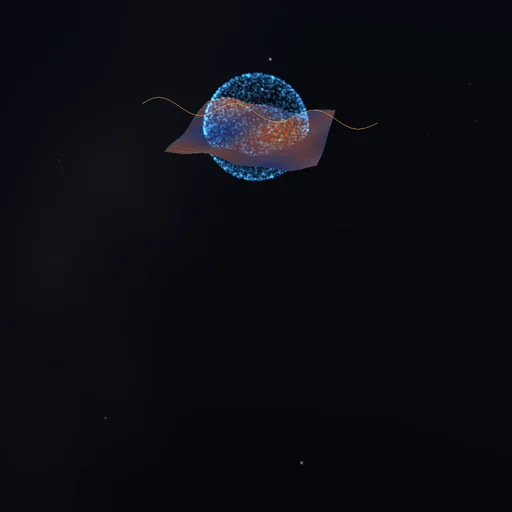
Stretching a tiny patch of the Universe — Actual application image

Astronomy

Stretching a tiny patch of the Universe

Increase the number of e-folds. Compare exponential expansion with a shrinking comoving Hubble radius and follow a perturbation as it crosses that scale.

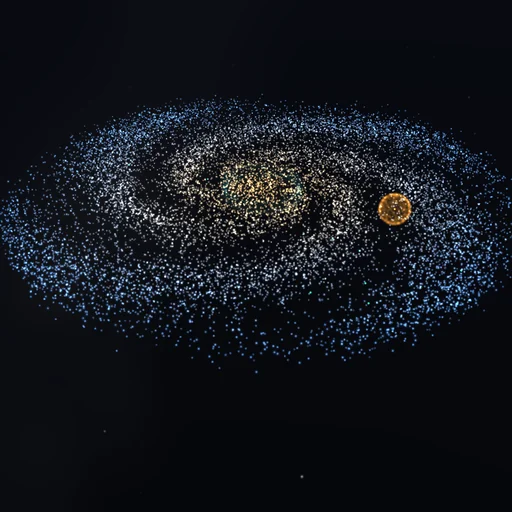
How many voices could share the Galaxy? — Actual application image

Astronomy

How many voices could share the Galaxy?

Change the assumptions in the Drake equation. Explore how communicative lifetimes and uncertain biological fractions change the expected number of contemporaries.

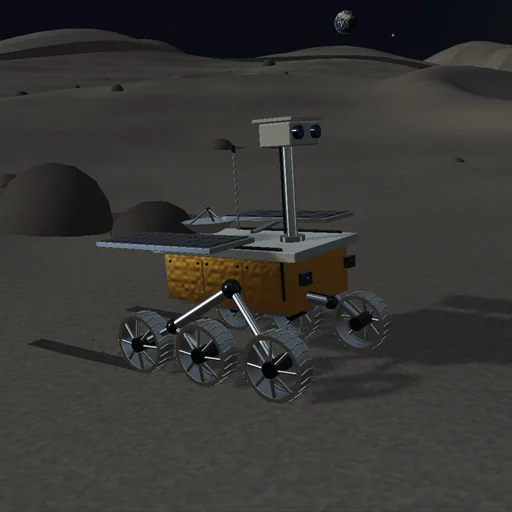
Lunar rover expedition — Actual application image

Astronomy / Engineering

Lunar rover expedition

Drive a six-wheel rover across a cratered lunar test field. Compare grip, suspension loads and the automatic survey route.