Math
The Turing machine and the busy beavers
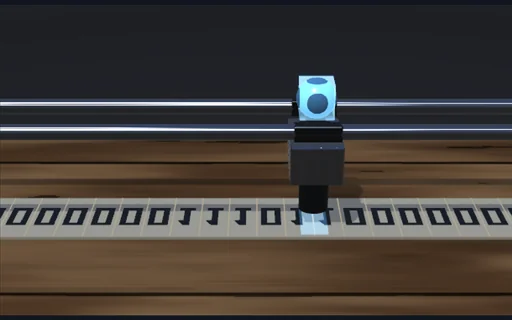
A paper tape between two reels, a metal head with a state lamp, and a table of rules. Every step plays as read, write, move, next state; the journal below holds the whole run, and an edited rule keeps the old run as a ghost. The records are found by enumerating every machine, not quoted.
What happens
A machine this small is a table and nothing else: for each state and symbol, what to write, where to move, which state follows - or halt. On the desk it is an apparatus: a paper tape between two reels, a head on rails with a lamp that shows its state. Every step is played in four phases - the head reads the cell, stamps the new digit, slides one cell, the lamp changes colour - and the sheet below keeps the journal, every step of the run as a heat map with a time axis. Click a step to hold the machine there. Click a token of the table to change a rule: the run before the edit stays as a glass ghost beside the new one, with the step where the two histories part. The busy beaver asks how long such a machine can run before halting. The records here are not quoted: all 64 one-state machines, all 20736 two-state machines and 1048576 three-state machines in normal form are built and run - three states give 21 steps at most and 6 ones at most, by two different machines. Four states cost 268 million machines, so that champion is taken as known and checked by running it: 107 steps, 13 ones. A machine that reaches the cap of 400 steps has not halted, and nothing on this card can say whether it ever will.
Equations used in the module
Equations
a machine is a table: for each (state, symbol) it says what to write, where to move (L or R) and which state comes next - or H, halt
the tape starts all zeros and is unbounded; the card's window holds 49 cells, enough for every machine it runs
S(n) - the most steps any halting machine with n states takes;  Σ(n) - the most ones any of them leaves behind
found by enumeration here, not quoted: n = 1 is 64 machines, n = 2 is 20736, n = 3 is 16^5 = 1048576 in normal form (first move 1RB)
S(1) = 1, Σ(1) = 1;  S(2) = 6, Σ(2) = 4;  S(3) = 21, Σ(3) = 6 - and for n = 3 those are two DIFFERENT machines
raising the step cap from 25 to 200 adds not one halting machine: every 3-state machine that halts, halts by step 21
n = 4 would cost 16^7 = 268435456 machines, so its champion is taken as known and checked by running: 107 steps, 13 ones
S(n) grows faster than any computable function - that is why the table above stops at four and not at ten