Math
Power of a point
Carry a point into a circle and watch the directed product of a secant's two segments change sign; turn the secant and the product stays. Then find the points of equal power for two circles, and the radical centre of three.
What happens
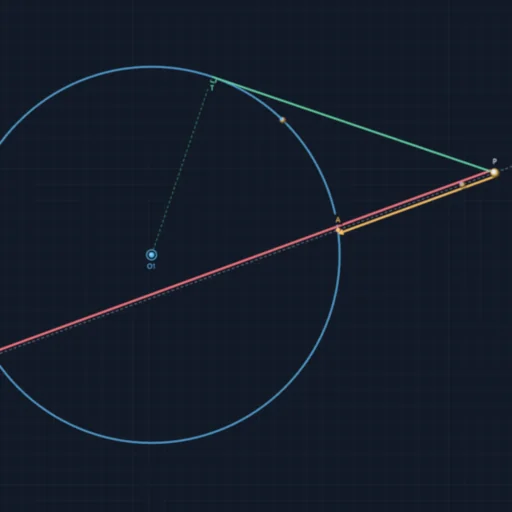
The power of a point P for a circle is |PO|² − R²: positive outside, zero on the circle, negative inside. Draw any line through P that meets the circle at A and B and measure along the line with a sign: PA·PB is the power, whatever the line. Outside, the tangent gives the same number as PT². For two circles the points of equal power form a straight line, the radical axis; for three, the three axes meet in one point. Start with one circle, then open the second and the third.
Equations used in the module
Equations
Π(P) = |PO|² − R²:  > 0 outside, = 0 on the circle, < 0 inside
secant through P meeting the circle at A, B (directed along the line):  PA·PB = Π(P)
unsigned lengths:  |PA|·|PB| = |Π(P)|;  outside, tangent PT:  PT² = Π(P)
two circles, centres apart:  Π₁(X) = Π₂(X)  is a line perpendicular to O₁O₂ - the radical axis
concentric: no such line (R₁ ≠ R₂: no point; R₁ = R₂: every point)
three circles, centres not collinear:  the three axes meet at the radical centre