Math
Circle of Apollonius
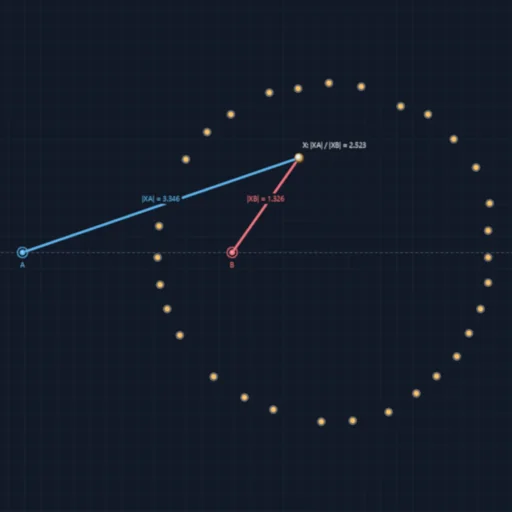
Carry a probe with two measuring tapes to A and B and leave a mark wherever |XA| : |XB| = k; reveal the circle the marks lie on, then carry k slowly through 1 and watch the circles open into the perpendicular bisector.
What happens
Pin down two points A and B and ask where a point X can be if it is k times as far from A as from B. Measure: move the probe, read the two tapes, and leave a mark each time the ratio is right. The marks fall on a circle - Apollonius's - whose centre lies on the line AB. At k = 1 the circle becomes the perpendicular bisector; near 1 it is enormous, and only a nearly straight piece of it crosses the sheet.
Equations used in the module
Equations
|XA| = k·|XB|,  k > 0
k ≠ 1:  a circle, centre C = (A − k²B)/(1 − k²), radius r = k·|AB| / |1 − k²|
k = 1:  the perpendicular bisector of AB
A and B are inverse points of every circle of the family:  CA·CB = r²
k → 1:  r → ∞ and the centre runs off along AB; the circles open into the bisector