MakarovSuites
English
EnglishDeutschРусскийУкраїнськаFrançaisEspañolItalianoPolski
Contact & licences

Math

Ptolemy’s inequality

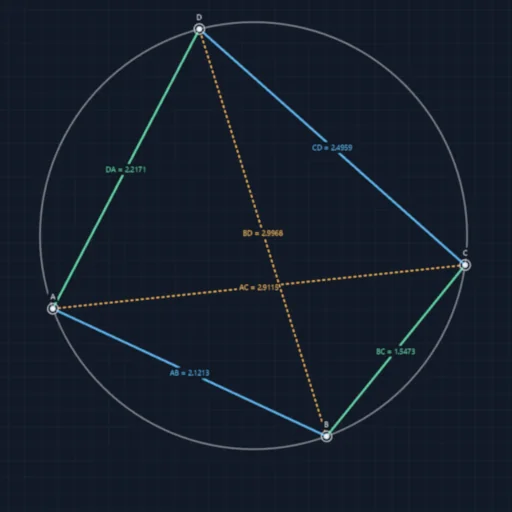
A quadrilateral in a circle and its three products as rectangles at one scale: AB·CD and BC·DA laid end to end match AC·BD exactly while D stays on the circle. Unpin D and move it inside - the equality goes and an inequality stays.
Ptolemy’s inequality — Actual application image
Actual application image

What happens

For a quadrilateral ABCD inscribed in a circle, the product of the diagonals equals the sum of the products of opposite sides: AB·CD + BC·DA = AC·BD. Move any vertex along the circle and the equality holds; take D off the circle and it becomes an inequality, the left side always larger. The rectangles show the three products at one scale; they are an image of the numbers, not a cutting and rearranging of the rectangles.

Equations used in the module
Equations
A, B, C, D in this order
AB·CD + BC·DA ≥ AC·BD
equality ⇔ ABCD is a convex quadrilateral inscribed in a circle
gap = AB·CD + BC·DA − AC·BD ≥ 0
a self-intersecting ABCD is not the quadrilateral the equality is about
Related experiments

Back to catalogue
Cyclic and tangential quadrilaterals — Actual application image

Math

Cyclic and tangential quadrilaterals

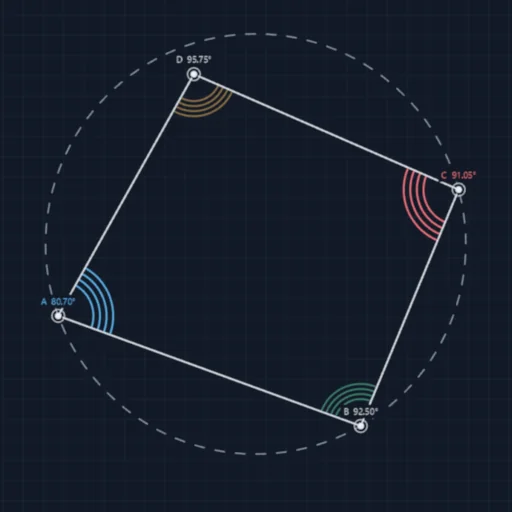
Two different tests, two experiments: move D until the opposite angles add to 180° and a circle passes through all four vertices; then build a quadrilateral whose opposite sides have equal sums and a circle touches all four sides. Break each on purpose, and decide which circle is possible.

Pantograph — Actual application image

Math

Pantograph

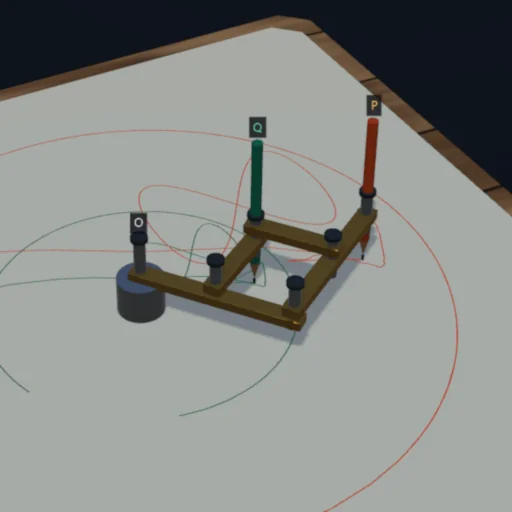
Draw with two pencils coupled by a brass linkage. Compare the original Q and its enlarged copy P on a wooden drawing board.

Constant width — Actual application image

Math

Constant width

Turn the parallel calipers around a Reuleaux triangle, circle and ellipse. The first two keep their width; the ellipse does not. The displayed perimeter uses a fine polygonal approximation.