MakarovSuites
English
EnglishDeutschРусскийУкраїнськаFrançaisEspañolItalianoPolski
Contact & licences

Math

Napoleon’s theorem

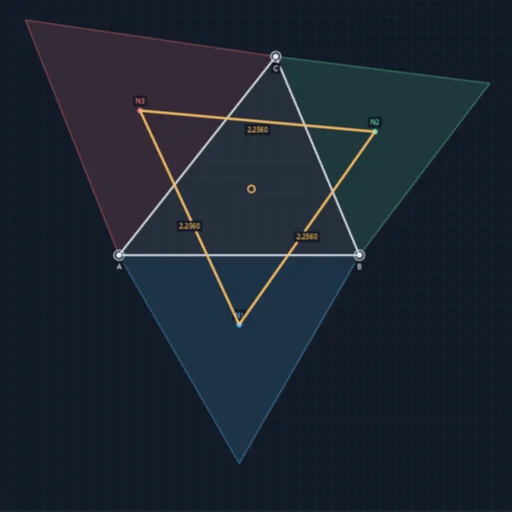
Erect an equilateral tile on each side of any triangle, mark the three centres and join them: an equilateral triangle, whatever the shape - then build the tiles inward, as a separate experiment, and compare the areas.
Napoleon’s theorem — Actual application image
Actual application image

What happens

Take any triangle and build an equilateral triangle outward on each of its sides. Mark the centre of each and join the three centres: the result is always equilateral, and it is centred on the centroid of the original. Build the equilateral triangles inward instead and the three centres again make an equilateral triangle, smaller - and the two areas differ by exactly the area of the triangle you started from.

Equations used in the module
Equations
on each side of ABC an equilateral triangle, erected outside (inside for the inner experiment)
N₁, N₂, N₃ = the centres of the three equilateral triangles
|N₁N₂| = |N₂N₃| = |N₃N₁|  for every triangle ABC, flat ones included
the centre of N₁N₂N₃ is the centroid of ABC
area(outer) − area(inner) = area(ABC)
Related experiments

Back to catalogue
Ptolemy’s inequality — Actual application image

Math

Ptolemy’s inequality

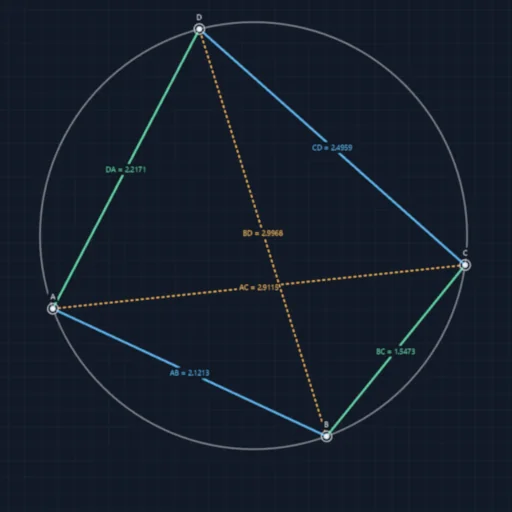
A quadrilateral in a circle and its three products as rectangles at one scale: AB·CD and BC·DA laid end to end match AC·BD exactly while D stays on the circle. Unpin D and move it inside - the equality goes and an inequality stays.

Cyclic and tangential quadrilaterals — Actual application image

Math

Cyclic and tangential quadrilaterals

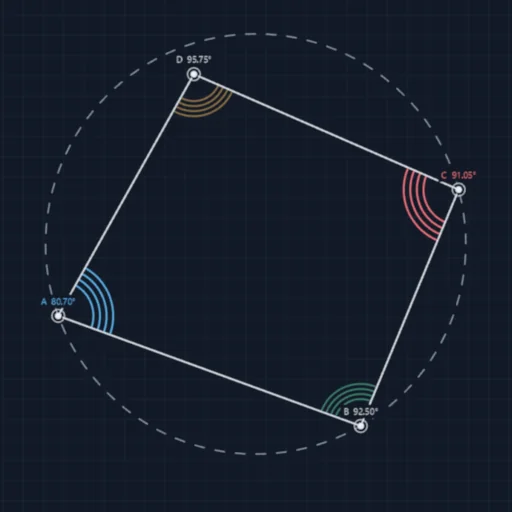
Two different tests, two experiments: move D until the opposite angles add to 180° and a circle passes through all four vertices; then build a quadrilateral whose opposite sides have equal sums and a circle touches all four sides. Break each on purpose, and decide which circle is possible.

Pantograph — Actual application image

Math

Pantograph

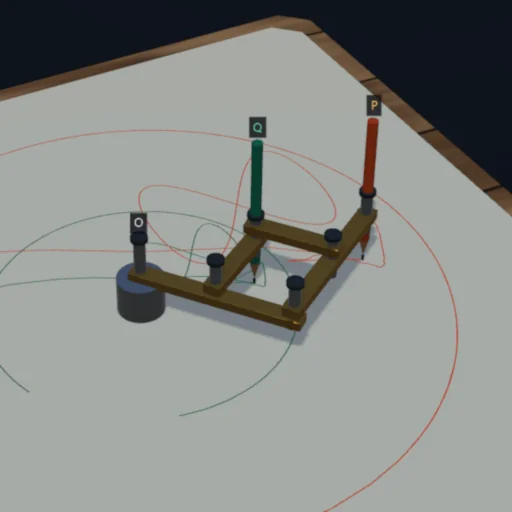
Draw with two pencils coupled by a brass linkage. Compare the original Q and its enlarged copy P on a wooden drawing board.