Math
Simson line
Collapse a coloured pedal triangle into the Simson line. Then move P around a fixed triangle and reveal the Steiner deltoid behind the growing family of lines.
What happens
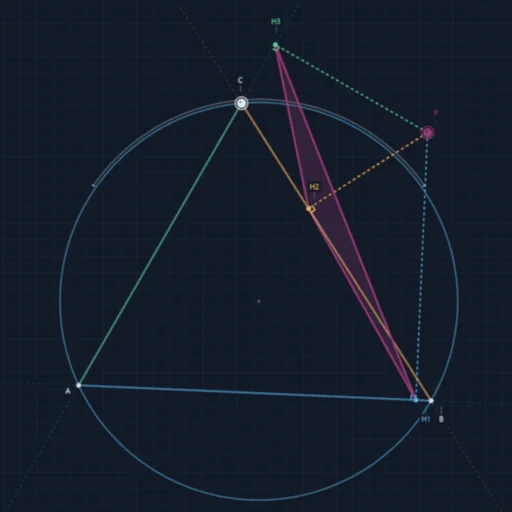
Drag P onto the blue circle. Watch the filled pedal triangle shrink into a line; leave the circle to restore its area. Move P around the circle or run one revolution. Blue lines accumulate for this fixed triangle; reveal the pink analytic envelope separately. H1, H2, H3 are perpendicular projections onto the side lines, including their extensions. They are collinear exactly when P is on the circumcircle. The pedal-area ratio is |1−ρ²|/4. For a fixed triangle, Simson lines envelop a Steiner deltoid. The short trace, accumulated blue lines and calculated pink curve are distinct objects. Drag P freely or along the circle. C moves on the marked 35°–145° arc; A and B are fixed. Changing C clears all old lines. Right drag pans, wheel zooms; click slider numbers for exact input. Pause stops the revolution; manual motion stops it too.
Try this
Move P onto the circumcircle. Its three perpendicular feet become collinear. Moving P away creates a pedal triangle whose area is measured against the exact formula.
Equations used in the module
Equations
H = A + (B−A) ((P−A)·(B−A)) / |B−A|²
ρ = OP/R; S(pedal)/S(ABC) = |1−ρ²|/4
ρ = 1 ⇔ H1,H2,H3 collinear (nondegenerate ABC)
O = 0; A = R exp(ia), B = R exp(ib), C = R exp(ic); Σ = a+b+c
N = (A+B+C)/2; z(φ) = N + R exp(iφ) + (R/2) exp(i(Σ−2φ))
direction(Simson) = (Σ−φ)/2 mod π; z(φ) lies on that line
z′(φ) = iR [exp(iφ)−exp(i(Σ−2φ))]; cusps: 3φ = Σ mod 2π
ABC fixed during each accumulated family; changing C clears its history