Engineering
Toggle press
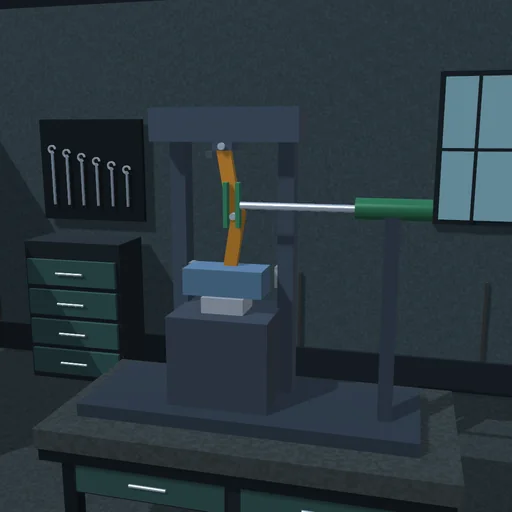
Push the knee with a few hundred newtons and watch the press force grow as the links straighten. On steel the knee stops short of the centre; push harder, or press wood, and it goes over the centre and locks - switch the actuator off and the press still holds.
What happens
Two links of 0.5 m hang from the top pin: the upper one to the knee, the lower one from the knee to the ram, which runs in vertical guides over a specimen set a gap above the ram’s lowest point. An actuator rod pushes the knee sideways towards the line through the top pin and the ram. As the links straighten, the same push presses ever harder: with the links at θ from the line the specimen takes S = F/(2·tan θ) plus the weights of the ram and a link.
On steel (k = 5·10⁶ N/m) 2 mm below the ram’s stroke, 300 N stops the knee at 3.0° with 3.07 kN on the specimen, a gain of 10; with 10 mm to go it stops at 8.0° with 1.29 kN. From 471 N up the knee goes over the centre onto its stop 2° past it, and the press locks: switch the actuator off and the steel still carries 6.95 kN. Softer wood lets 300 N carry the knee straight over. The actuator’s work ends as the specimen’s elastic energy and the weights’ potential energy.
Model: rigid links, ram and rod on revolute joints and a slot; the specimen is a spring with damping; the actuator pushes with a capped force at a set speed. No friction.
Try this
Press steel with 300 N and read the press force. Raise the push past 470 N: the knee snaps over and locks; switch the actuator off.
Equations used in the module
Equations
y_ram = T − 2L·cos θ
S = F/(2·tan θ) + (m_ram + m_link)·g
S = k·δ
W_F = k·δ²/2 + ΔE_p