Engineering
Friction clutch
Engage the clutch abruptly and gently, then with double the flywheel inertia: against a motor that holds its speed, the slip heat equals the energy the flywheel gains, whatever the ramp.
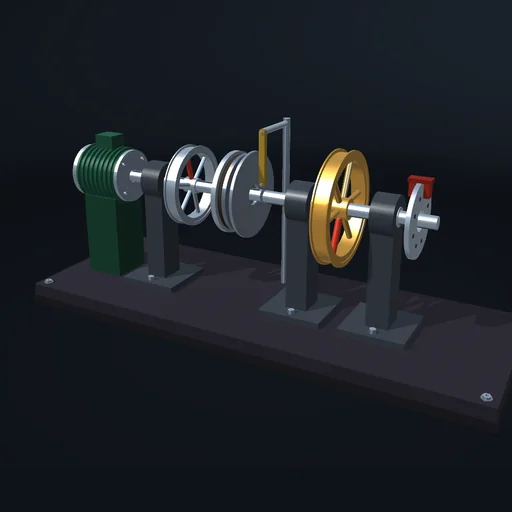
What happens
A motor drives the input flywheel; a dry plate clutch with two friction faces of mean radius r joins it to the output flywheel, which a brake loads. On engagement the clamp force F rises over the ramp time, and the clutch can carry at most T = μFzr (z = 2 faces). While the plates slip, the clutch torque sits at that limit and the slip work turns into heat; when the speeds meet, the plates lock and carry only what the load needs. Against a motor that holds its speed, an unloaded engagement turns into heat exactly the energy the output flywheel gains, ½J₂ω², however abruptly or gently it is done: a gentle engagement only takes longer. A load torque adds heat and delays the lock. With the motor off, the two flywheels share their angular momentum, and the heat is the kinetic energy lost.
Model: rigid shafts; the clutch is a friction coupling that sticks or slips (Coulomb friction), and the clamp force ramps linearly; the heat goes into a lumped plate that cools. No wear, and μ does not change with temperature or speed.
Try this
Engage abruptly (ramp 0) and gently (ramp 2–3 s) and compare the heat; then double the output inertia.
Equations used in the module
Equations
Tmax = μ·F·z·r
J₂ dω₂/dt = T − TL
Q = ∫ T·(ω₁ − ω₂) dt
ω₁ = ω₀, TL = 0  ⇒  Q = ½ J₂ ω₀²