Engineering
Scissor lift
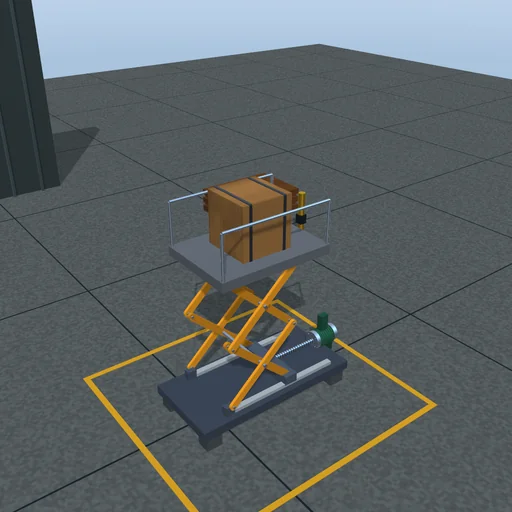
Raise the deck with one, two or three stages and watch the screw’s pull: it is greatest at the bottom and falls as the arms rise. Move the load along the deck: the pull stays the same, only the pin and the roller under the deck share the load differently.
What happens
Each stage is two crossed arms of 0.8 m pinned at their middles; the stages are pinned end to end. The bottom stage stands on a fixed pin at the left and on a carriage at the right that a screw draws along the base; the top stage carries the deck on a pin at the left and on a roller under the deck at the right. Drawing the carriage in by Δx raises the deck n times as much in proportion: the deck stands at h = n·a·sin θ.
The screw pays for the lift as it goes, so its pull is the weight times the deck’s rise per unit of the carriage’s travel: F = (W·n + m·g·n²)·cot θ, with W the weight of load and deck and m an arm’s mass. It is largest at the bottom - two stages under 100 kg need 9.37 kN at 15°, 4.35 kN at 30° and 2.51 kN at 45°; three stages 14.5 kN at 15°. Moving the load along the deck changes nothing of this: only the pin and the roller under the deck share the weight differently, by the lever rule.
Model: rigid arms, deck and carriage on revolute joints, a roller row under the deck and a guide for the carriage; the screw is a speed drive with a force cap. The load is a weight on the deck. No friction.
Try this
Lift two stages from the bottom and watch the screw pull fall. Then move the load to the deck’s end: the pull stays, the roller takes more.
Equations used in the module
Equations
h = n·a·sin θ
F = (W·n + m·g·n²)·cot θ
F_roller·b = W·(b/2 + x)
W_F = ΔE_p