Engineering
Cooling tower
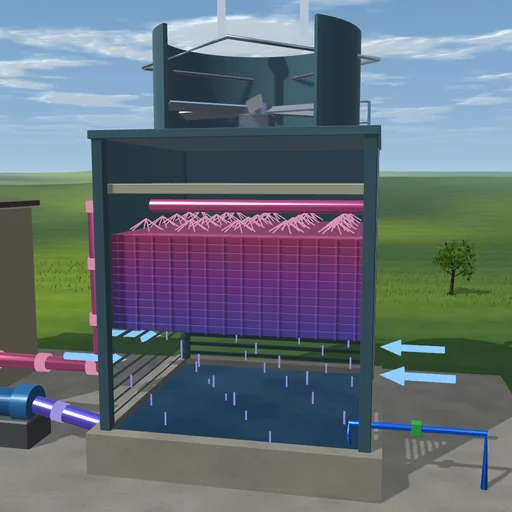
Cool a plant’s condenser water by letting it rain through the fill against the air the fan draws up. Change the heat load, the fan and the weather: the water never gets colder than the air’s wet bulb, and on a cold, humid day a plume of fog rises from the stack.
What happens
A cell of 3 × 3 m with 1.2 m of fill cools the water of a plant’s condenser. The water falls through the fill and the fan draws the air up through it; in each of twelve layers the air approaches the state of the water’s surface: its moisture relaxes towards the saturation moisture at the water’s temperature with the transfer units h_d·a·V/q_a (q_a and q_w are the mass flows of air and water), its temperature towards the water’s with Lewis’s factor of 0.92 in addition. Most of the heat goes into evaporating a little of the water; what the air gains in enthalpy, the water loses. Air that leaves a layer supersaturated condenses the excess as fog. The basin under the fill mixes the cooled water with fresh make-up water and sends it back to the condenser.
With 600 kW on 15 kg/s and air at 25 °C and 50 % (wet bulb 17.9 °C), the basin settles at 24.2 °C: the water is cooled through a range of 9.4 K to an approach of 6.5 K above the wet bulb, and 0.22 kg/s evaporates – 0.15 % of the flow for each kelvin of range. Twice the heat raises the basin to 27.1 °C. Drier air cools further: at 15 % the fill’s outlet falls from 25.5 to 23.0 °C, while half the air raises it to 29.3 °C. On a cold, humid day of 5 °C and 80 % the air leaves at 22.4 °C, saturated and carrying 1.07 g of fog per kilogram – the plume; the basin settles at 16.1 °C.
Model: twelve layers in counterflow, solved by shooting from the bottom; Buck’s saturation pressure; a constant Lewis factor; the transfer coefficient 1.8·q_w^0.4·q_a^0.6; the basin of 4 t one well-mixed mass; the fan’s power as the cube of its speed; RK4 at 1 s.
Try this
Let the basin settle, then double the heat load or slow the fan and watch the approach. Make the air dry, then cold and humid: the plume appears.
Equations used in the module
Equations
w_out = w_s(T_w) − (w_s(T_w) − w)·e^(−NTU)
T_out = T_w − (T_w − T_a)·e^(−Le·NTU)
h = 1006·t + w·(2.501·10⁶ + 1860·t)
q_w·c·ΔT_w = q_a·Δh