Engineering
Seismic isolation
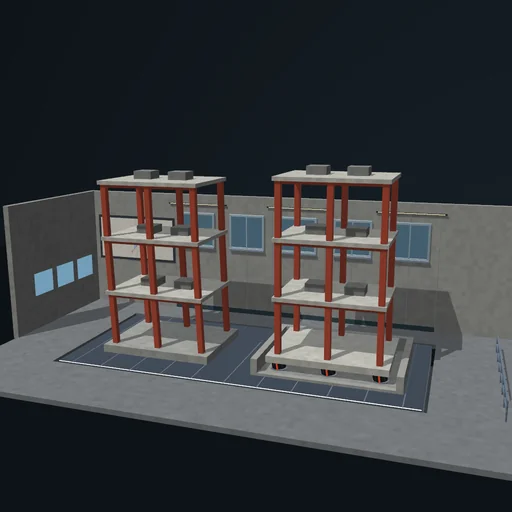
Shake two identical buildings on one table: one stands on its foundation, the other on lead-rubber bearings. Compare how hard their roofs are thrown, change the bearings' period and damping, and send a long pulse that drives the base into its moat.
What happens
Two identical three-storey buildings stand on the same shaking ground. Each floor is 350 t on a storey of shear stiffness 600 MN/m, damped by 5 % in the first mode; the fixed building's modes have periods of 0.341, 0.122 and 0.084 s. The isolated one stands on a 400 t slab carried by lead-rubber bearings: a Bouc–Wen element whose stiffness after yield is set by the isolation period and whose yield force is a share of the weight, with a viscous damper beside it; past the moat's gap the slab strikes a stiff wall. The ground moves by a synthetic record (harmonics shaped by a Kanai–Tajimi spectrum under an envelope), by a single long pulse or by a steady harmonic.
In a record of 0.35 g at 0.4 s the fixed roof is thrown at 9.58 m/s² and the isolated roof at 1.45 m/s², while the base travels 72 mm and the lead turns 475 kJ into heat. Without the lead the roof gets 1.28 m/s², but the base swings 188 mm. A pulse of 0.3 g lasting 2.5 s, near the isolation period, drives the base 310 mm into a moat of 0.3 m: it strikes the wall twice, and the isolated roof takes 34.0 m/s², far more than the fixed one's 3.29 m/s². With a gap of 1 m the base travels 1.00 m and the roof still gets 18.4 m/s².
Model: shear frames of three masses; the bearings' hysteresis by Bouc–Wen with n = 2 and β = γ = ½; the wall a stiff spring with a damper; no soil–structure interaction, no vertical or rocking motion. The journals of both buildings close on the ground's work. Steps of 2.5 ms.
Try this
Watch both roofs in the earthquake record, then send the long pulse near the bearings’ period and see the base strike the moat’s wall. Widen the gap, take out the lead with a yield force of zero, or add damping.
Equations used in the module
Equations
M·d²u/dt² + C·du/dt + K·u = −M·1·a_g
F = α·k₁·u + (1 − α)·k₁·u_y·z
dz/dt = (du/dt)/u_y·(1 − |z|²·(β·sgn(z·du/dt) + γ))
α·k₁ = M_total·(2π/T_iso)²