Engineering
Ferris wheel
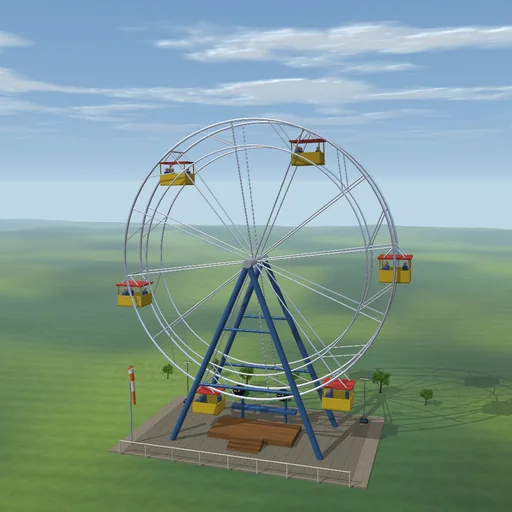
Seat the riders, start the wheel and turn it once round. Load one side, weaken the drive, let the wind blow or stop it hard, and watch the gondolas swing on their pins while the drive works against the uneven weight.
What happens
Six open gondolas hang from pins on a circle of 10 m radius on a rim of 1000 t·m², which two drive tyres turn under a speed controller with a torque limit. Each gondola is a physical pendulum of 500 kg with its centre 1.6 m below the pin; riders of 75 kg sit 1.9 m below it. Nothing keeps a gondola level but gravity. The rim and the six gondolas are one system of seven degrees of freedom, solved every step together with the forces in the pins. Uneven loads ask the drive for torque on one half of the turn and give it back on the other; the wind pushes each gondola by its drag; the pins' dampers act on the swing relative to the rim; an emergency stop drops the drive and grips the rim with a brake.
A gondola with four riders, 800 kg with its centre 1.71 m below the pin, swings with a period of 2.85 s. A wind of 15 m/s pushes it with 953 N and holds it 6.9° from the vertical; an empty one 11.0°, a full one 5.8°. Turned at exactly 1 rpm with even loads, the gondolas keep swinging by 1.5°. With the drive off and one full gondola at three o'clock, the free wheel turns 84° in 10 s.
Model: a rigid rim on a fixed axle and rigid gondolas on frictionless pins with linear dampers; quadratic drag on each gondola at its speed through the air; the drive a PI controller of the speed with a torque limit; no flexing of the structure. RK4 with steps of 1/120 s; the journal closes on the drive's and the wind's work.
Try this
Start the wheel and let it turn once round; load one side and watch the drive’s torque change sign. Let the wind blow, weaken the pins’ damping or press the emergency stop, and watch the gondolas swing.
Equations used in the module
Equations
q = (φ, θ₁ … θ₆),  ψ_i = φ + 60°·i
T = ½J·φ'² + Σ ½m·(R²φ'² + l²θ'² + 2Rl·φ'θ'·sin(θ − ψ)) + ½I·θ'²
V = Σ m·g·(R·sin ψ − l·cos θ)
F_wind = ½ρ·C_d·A·|v_rel|·v_rel