Engineering
Marine sextant
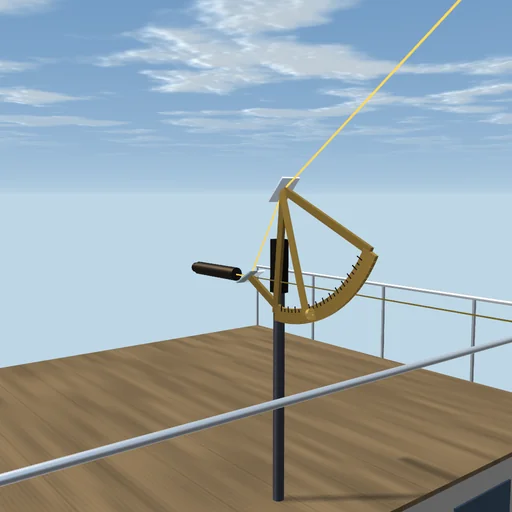
Take a sight from a rolling ship: move the index arm and its drum until the star or the Sun's lower limb touches the sea horizon, then reduce the reading for index error, dip and refraction. Swing the arc to find the lowest point of the image's path, and see what a tilted frame and an uncorrected sight cost.
What happens
Light from the star or the Sun's lower limb strikes the index mirror, which turns with the index arm, then the half-silvered horizon mirror, and enters the telescope beside the direct view of the horizon. Both reflections are computed as reflections, d′ = d − 2(d·m)·m; together they turn the ray by twice the angle between the mirrors, whatever its incidence, so the arc is divided in double degrees: the rack gives whole degrees and the drum minutes. The sea horizon lies below the true horizontal by the dip, 1.76′·sqrt(h), and a star appears higher than it is by the refraction (Bennett).
For a star at 35° seen from 10 m the dip is 5.57′ and the refraction 1.42′: the image meets the horizon at a reading of 35.1164°, and the reduced sight gives 35° back. An index error of +2′ moves the reading to 35.1497°; left uncorrected, the sight is 9.0′ too high. The Sun at 20°: its lower limb comes down at 19.8710°. A frame tilted about the line of sight needs a larger reading: 1.4′ more at 2°, 8.9′ at 5° and 36.2′ at 10°. On a rolling deck the image swings in an arc and touches the horizon at its lowest point, where the frame is plumb.
Model: plane mirrors and exact vector reflections; the star dead ahead; no prismatic or centring error. An observer swinging the arc keeps a tenth of the roll in the frame.
Try this
Bring the image down with the arm and the drum until it touches the horizon, then take a sight. Let the ship roll and swing the arc: set the reading where the image just touches the horizon at the bottom of its path.
Equations used in the module
Equations
d′ = d − 2(d·m)·m
H_s = H_a + dip + IE,  dip = 1.76′·sqrt(h)
R = cot(H + 7.31/(H + 4.4))′
H_o = H_s − IE − dip (+ SD) − R