Engineering
Film projector
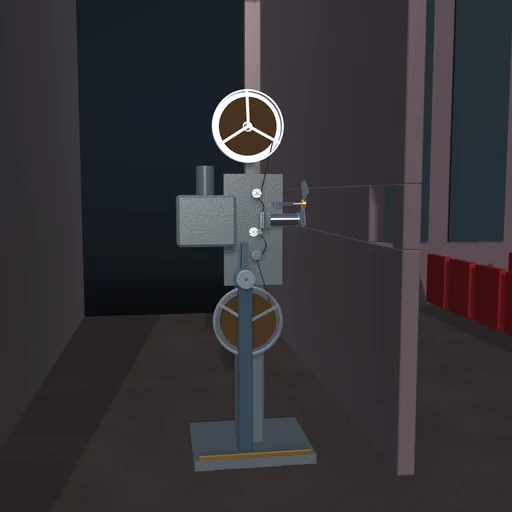
Watch a 35 mm projector's intermittent movement in slow motion: the Geneva cross pulls each frame into the gate and holds it still while the shutter opens. Turn the shutter out of phase and the picture smears, change the frame rate, and thread the loops too short to see them snap taut and tear.
What happens
A four-slot Geneva wheel turns the intermittent sprocket a quarter turn, one frame of 19 mm, while its driver's pin is in a slot - a quarter of each revolution - and locks it for the other three. The cross follows tan β = λ·sin ψ/(1 − λ·cos ψ) with λ = sin 45°: it peaks at λ/(1 − λ) = 2.414 times the driver's speed, so at 24 frames a second the film moves at up to 4.40 m/s and starts with an acceleration of 275 m/s². The film in the gate is a damped mass on the elastic strip between the sprocket and the gate, natural at 400 Hz; the projected frame stands where the film actually is, magnified onto a screen 6 m wide. A two-bladed shutter on the driver's shaft cuts the light during the pull-down and once more between, so the screen flickers at 48 Hz with half the light. Loops above and below the gate take up the difference between the continuous sprockets and the intermittent one.
Set on the pull-down, the shutter hides the travel: only the strip's settling remains, 17.6 mm on the screen. Turned 30° late it lets a sixth of the light fall on the moving film, and the picture smears by 0.81 m; 5° late it hides the settling, 9.6 mm, at the price of 2.8 % of the light. At 18 frames a second the smear falls to 9.8 mm. A loop threaded shorter than 12.18 mm goes taut at every pull-down, and below 12.08 mm its tension passes 20 N and tears the perforations.
Model: the Geneva's kinematics exact; the strip one degree of freedom damped by 30 %; the loops' slack from the sprockets' feeds, a taut loop a stiff spring; no lens aberrations. Steps of 0.1 ms.
Try this
Run the film slowly and watch the cross pull a frame into the gate while a blade is across the beam. Turn the shutter’s phase and watch the picture on the screen smear; shorten the loops until they snap taut.
Equations used in the module
Equations
tan β = λ·sin ψ/(1 − λ·cos ψ),  λ = sin 45°
d²y/dt² + 2ζω·dy/dt + ω²·y = −d²x/dt²
d(slack)/dt = v_continuous − v_intermittent
smear = M·(largest − smallest offset while lit)