Engineering
Electromechanical telegraph
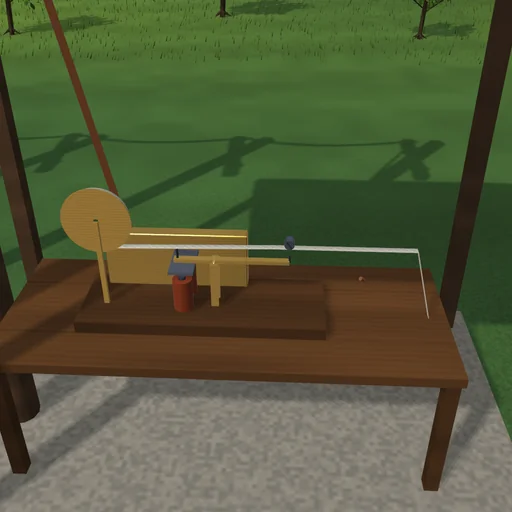
Send Morse code down a telegraph line and watch it arrive: the line charges section by section, the register's armature is pulled across its gap and the stylus presses dots and dashes into the paper tape. Lengthen the line, lay it as a cable, change the spring and the sending speed, and see when the marks smear and when they stop.
What happens
A key and a battery of 60 V stand at one end of a line, a register at the other. The line is a ladder of up to eight RC sections - an overhead wire of 15 Ω and 10 nF per kilometre, or a cable of 5 Ω and 200 nF - with the earth as its return. The register's coil of 150 Ω has the inductance of its magnetic circuit, L(g) = L_leak + μ₀·N²·A/(2g), and pulls its armature with F = μ₀·N²·A·i²/(4g²) across an air gap that closes from 1.0 to 0.4 mm, against a spring of 100 N/m preloaded by 0.2 mm; the coil's equation keeps the motional EMF. At the front stop the stylus presses the paper tape, which runs at 20 mm/s; the marks are read back as dots and dashes by their lengths.
The armature lifts off its back stop at 12.6 mA and falls back below 10.1 mA. Over 200 km of overhead wire the current with the key down is 18.9 mA; a dot at 20 words a minute arrives 19.8 ms late and leaves a mark of 42 ms for the 60 ms it was sent. Over 20 km the delay is 2.5 ms. Through 300 km of cable SOS arrives as SOS, its first mark 27.1 ms after the key; sent at 40 words a minute it reads ATA. Through 800 km of cable the coil sees at most 13.6 mA and nothing reaches the paper; with the spring's preload halved the armature closes once, and the whole message is one long smear.
Model: lumped RC sections, at most eight; the coil's inductance from its gap; the armature a mass on a spring with damping between two stops; no leakage to earth, no relays. Steps of 20 µs; the journal closes on the battery's work.
Try this
Watch SOS travel down the line and arrive on the tape. Lay the line as a cable, make it longer or send faster and see the marks smear; ease the spring when nothing arrives, or hold the hand key down.
Equations used in the module
Equations
C·dV_k/dt = i_(k−1) − i_k,  i_k = (V_k − V_(k+1))/R
d(L(g)·i)/dt = V_n − R_coil·i
L(g) = L_leak + μ₀N²A/(2g),  F = μ₀N²A·i²/(4g²)
m·d²x/dt² = F − k·(x₀ + x) − c·dx/dt