Engineering
Water clock
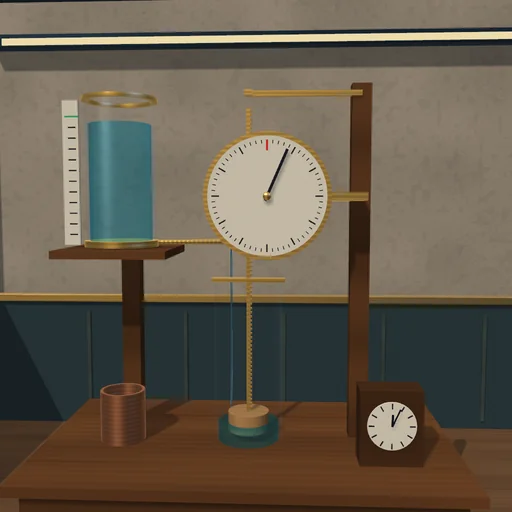
Let water run out of a vessel through a small hole and measure time by the float rising in the receiver. Compare a cylinder, a cone and the profiled vessel, keep the head constant with an overflow tank, and calibrate the scale to see the clock read true.
What happens
Water runs out of the upper vessel through an orifice of 1.6 mm with a discharge coefficient of 0.62 into a glass receiver of 0.1 m radius, where a float of 0.4 kg rises and lifts a rack; its pinion turns the dial's hand once for every 0.4 m of rise. The outflow follows Torricelli, Q = C_d·a·sqrt(2gh): 3.49 mL/s at a head of 0.4 m. A uniform scale is laid out by the starting rate; a calibrated one by a run of the clock itself.
From a cylinder of 0.1 m radius filled to 0.4 m the flow falls with the head: after 30 min the uniform dial is 225 s slow, after an hour 900 s, after 90 min 2026 s, and the cylinder empties in 2 h. A cone wider at the top falls more slowly at first: its dial is 137 s slow after 30 min, while the scale on its wall runs 280 s fast. The profiled vessel, whose radius grows as the fourth root of the height, lets its level fall at a steady 0.070 mm/s, so the scale on its wall is uniform; it empties in 96 min. A constant-head tank fed with 9 mL/s keeps its level 0.8 mm above the overflow's lip: the outflow stays at 3.50 mL/s, the rest spills, and after an hour the dial is only 3.7 s fast. The receiver holds 15.3 L.
Model: quasi-steady Torricelli flow through the orifice and a weir over the overflow's lip; the float rests on the floor until the water reaches its draft of 26 mm; no surface tension, temperature or viscosity effects. RK4 with steps of 0.1 s; water is neither made nor lost.
Try this
Run the cylinder and compare its dial with the clock on the cabinet; then try the cone, the profiled vessel and the constant-head tank. Switch on the calibrated scale and watch the error vanish.
Equations used in the module
Equations
Q = C_d·a·sqrt(2g·h)
A(h)·dh/dt = Q_supply − Q − Q_overflow
Q_overflow = C_w·L·sqrt(2g)·(h − h_lip)^(3/2)
rise = (V_receiver − V_draft)/A_receiver,  hand = rise/r_pinion