Engineering
Mechanical tide predictor
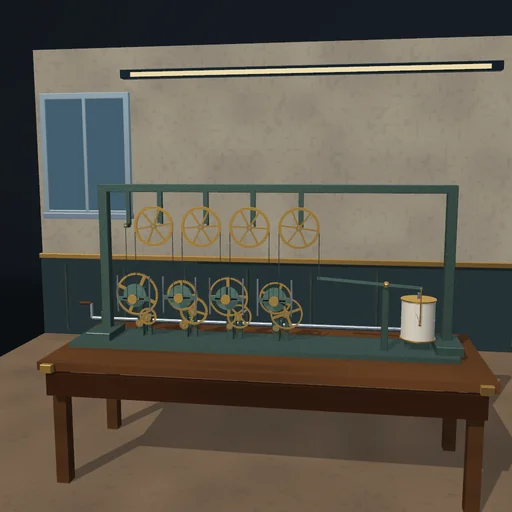
Set the amplitudes and phases of four tidal constituents on the cranks of a Kelvin-style machine and watch one wire add their motions into the tide curve on the paper drum. Compare slotted yokes with plain cranks, push an amplitude past the slide's stroke, and run the machine for a year to see its gear trains drift from the true speeds.
What happens
An hour shaft, turned once an hour, drives four cranks through two-stage gear trains whose tooth counts approximate the speeds of the constituents M2, S2, K1 and O1: 17/41·20/103 gives M2 28.984135°/h against the true 28.984104°/h, and 15/50·15/54 gives the 30°/h of S2 exactly. Each crank moves a pulley up and down by s·A·cos(ωt − g), on a paper scale s of 20 mm for every metre of tide. One wire runs from its anchor under the four pulleys and over four guide wheels, so that its length changes by twice the sum of their motions, and a 2:1 lever gives the pen the sum. The pen draws on a drum that turns once in four days; the exact sum at the true speeds is drawn beside it.
With slotted yokes the machine adds exactly. For the semidiurnal set (M2 1.8 m, S2 0.6 m, K1 0.08 m, O1 0.07 m) it starts at 2.39 m and finds the next high water 16 min later at 2.42 m. M2 alone gives a high water every 12.42 h. Plain cranks, which swing the pulleys sideways and tilt the wire, draw up to 8 cm of tide wrong within the first day. The trains drift by 0.27° a year for M2, 0.52° for K1 and −0.98° for O1: after 365 days the machine draws 0.150 m where the true constituents give 0.157 m. A slide's stroke of 60 mm limits an amplitude to 3 m.
Model: the wire inextensible and taut, its path over the pulleys and guides computed exactly with its arcs of contact; the gears perfect; the machine a function of the hour shaft's turns. Steps of 10 s.
Try this
Watch the pen draw the semidiurnal tide, then choose a mixed or a diurnal one. Switch to plain cranks and see the error grow; speed the time up to a year and watch the gears drift from the true sum.
Equations used in the module
Equations
h(t) = Σ A_k·cos(ω_k·t − g_k)
ω_k = 360°·(a·c)/(b·d) per hour
pen = (L₀ − L(t))/2,  y_k = s·A_k·cos(ω_k·t − g_k)
L(t) = Σ tangent lengths + Σ arcs of contact