Engineering
Escalator mechanism
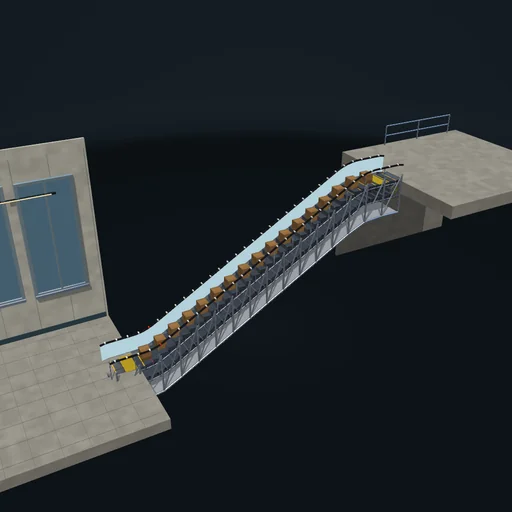
Follow the steps round the whole hidden loop: level up the incline, turning over the sprockets, upside down on the way back. Load the steps, run up or down, slacken the handrail or change its ratio, and stop the loaded band to see how far it slides.
What happens
An escalator of 84 steps on a closed chain 33.6 m long rises 6 m at 30°: an incline of 10.77 m between a concave and a convex transition of 2.0 and 2.6 m radius, flat landings with their combs, and turnarounds of 0.35 m round which the steps go back underneath, upside down. A step's front axle rides the chain; on the working branch its trailing wheels keep the tread level, so that the steps make a staircase on the incline and a floor on the landings. One coordinate moves the whole band: the induction motor's slip torque, limited to its breakdown torque, drives it through a gearbox of 110 against the weight of the steps on the slopes and of the loads they carry, rolling resistance and the brake. Loads board at one comb and leave at the other, bringing and taking their energy. The handrails run on their own wheel at a chosen ratio of the steps' speed; they grip by friction, T·(e^(μβ) − 1), and slip when more is asked of them.
Braked from 0.5 m/s by 30 N·m on the motor's shaft, the band going up half loaded with crates of 80 kg, 17 of them on it, stops in 0.147 m, and the empty band in 0.221 m: the weight helps the brake. Going down fully loaded with crates of 100 kg, 34 of them, even 60 N·m takes 0.511 m.
Model: the band rigid and the chain inextensible; each step's attitude from the paths of its two axles; a load a mass on its step; no walking riders, no stretch of the chain. RK4 with steps of 1/120 s; the journal closes on the motor's work.
Try this
Start the band and follow one step round the whole loop. Stop it loaded going up and going down and compare how far it slides; slacken the handrail or change its ratio and watch the hands drift.
Equations used in the module
Equations
M·d²s/dt² = F_motor − Σ m_i·g·sin τ(s_i) − F_roll − F_brake
T_motor = min(K·(ω_s − ω), T_max)
T_rail ≤ T·(e^(μβ) − 1)
step i: front axle at P(s + i·p), tread level on the working branch