Engineering
Suspension bridge
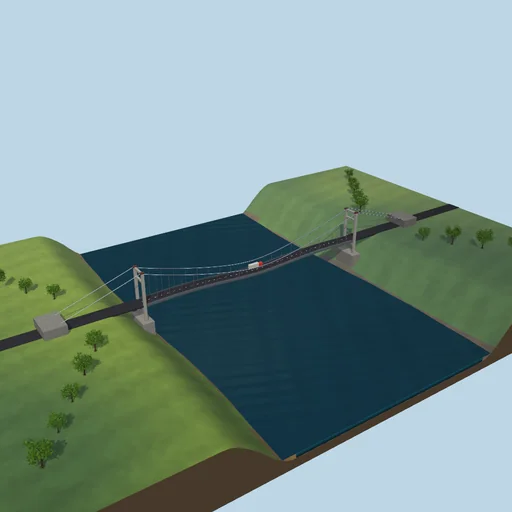
Park a lorry on the deck or drive it across, and watch the deck bend and the cables move, forty times enlarged. Read the hangers’ colours: which pull harder, which slacken. Cut a hanger, shorten the cables or lighten the deck, and see the bridge sway after a fast crossing.
What happens
A main span of 200 m hangs from two cables with a sag of 20 m between towers 25 m above the deck; nineteen pairs of hangers 10 m apart carry a stiffened deck of 8 t per metre. The cable’s shape is the funicular polygon of the loads it carries, so under its own weight the deck stays straight and the cable pulls the towers with H = 21.1 MN horizontally. The deck is a beam with EI = 2·10¹⁰ N·m², the cable a chain of stiff bars, the hangers bars that can only pull; the whole is solved with large displacements – by Newton’s method for the static states and by Newmark’s method for the motion.
A lorry of 40 t parked at midspan sinks the deck there by 65.2 mm – within 1 % of Melan’s deflection theory. Parked at a quarter of the span it sinks the deck there by 111.5 mm while the other quarter rises by 75.3 mm: the cable can hardly lengthen, so it changes shape. A cut hanger at 60 m lets the deck sag there by 25 mm, its neighbours taking its load. Shortening the cable by 0.05 % lifts the midspan by 204 mm. A lighter deck of 4 t/m tensions the cable less and gives 74.0 mm under the same lorry. The two lowest modes swing at 2.22 and 3.80 rad/s. A slow crossing bends the deck as the parked lorry does; a fast one leaves it swinging.
Model: a plane structure – the deck as Euler–Bernoulli beam elements, the cable and the hangers as bars that may turn freely, the towers fixed points; Rayleigh damping set to the chosen ratio at the two lowest modes; Newmark’s average acceleration with a modified Newton method at 0.02 s. Movements are drawn 40 times enlarged.
Try this
Park the lorry at midspan and read the deflection, then at a quarter of the span: the other half rises. Drive it across fast without damping and watch the bridge keep swinging.
Equations used in the module
Equations
H = M_mid/f
M·q″ + C·q′ + f_int(q) = f_ext(t)
N = EA·(l − l₀)/l₀ ≥ 0 in a hanger
C = α·M + β·K