MakarovSuites
English
EnglishDeutschРусскийУкраїнськаFrançaisEspañolItalianoPolski
Contact & licences

Math

Four colours for any map

Colour generated planar maps, inspect their adjacency graphs and compare greedy choices with a constrained backtracking search.
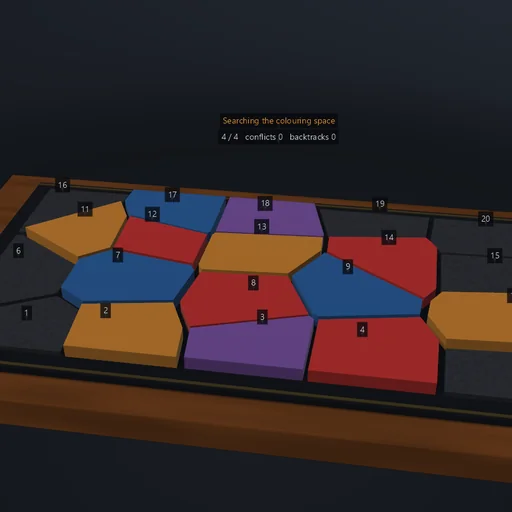
Four colours for any map — Actual application image
Actual application image

Try this

The map is a clipped Voronoi diagram; neighbours share an edge, not just a corner. Compare greedy colouring with saturation-ordered backtracking. Try a budget of two or three colours. The four-colour theorem concerns planar maps; this search demonstrates examples.

Equations used in the module
Equations
Adjacent regions must have different colours
Voronoi neighbours share a line segment of positive length
A planar map admits a proper colouring with at most four colours
Backtracking chooses a high-saturation vertex, tries a colour and retreats on failure
Related experiments

Back to catalogue
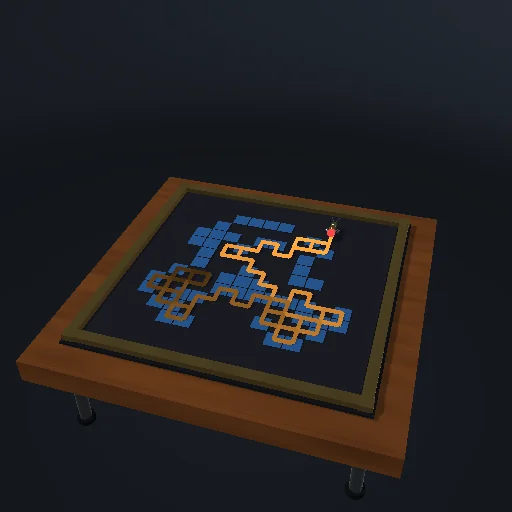
Langton's ant — Actual application image

Math

Langton's ant

Run Langton’s ant on a sparse unbounded lattice, change multicolour turn rules and inspect the classic 104-step highway.

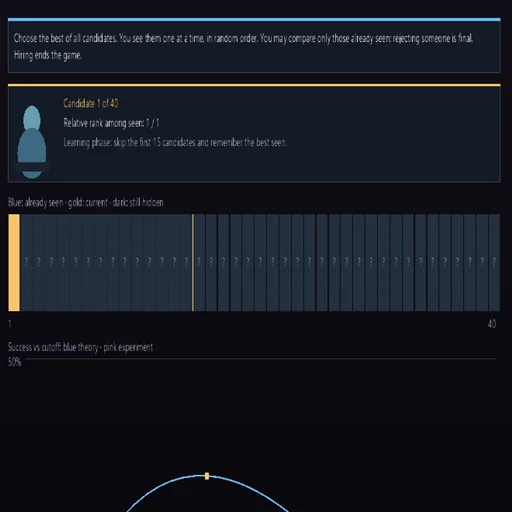
The secretary problem: stop at 37 % — Actual application image

Math

The secretary problem: stop at 37 %

Play an optimal-stopping game with hidden candidate quality, then compare cutoff strategies with exact probabilities and Monte Carlo trials.

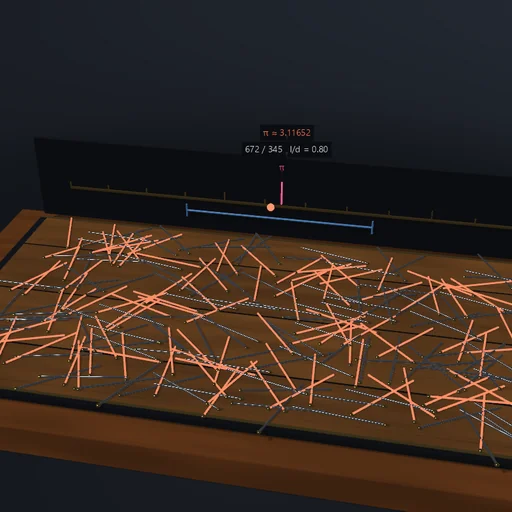
Buffon's needle — Actual application image

Math

Buffon's needle

Estimate π by throwing random needles across parallel lines, compare sample sizes and track a statistical uncertainty interval.