Engineering
Solar furnace
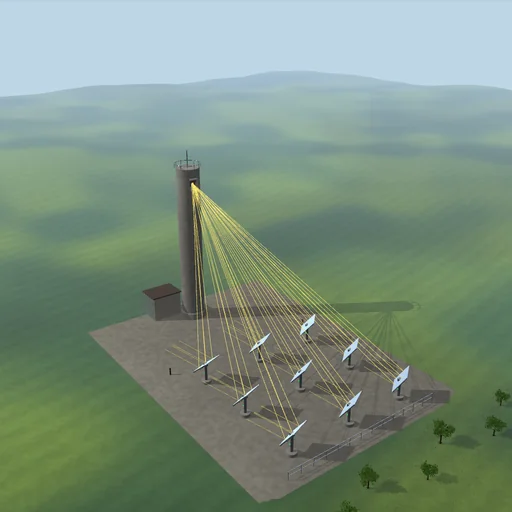
Nine mirrors follow the sun across the sky and send its light onto the receiver at the top of the tower. Watch the receiver heat to a glow, spread the aim or shrink the receiver to see how much spills, send a cloud across the field and compare the seasons.
What happens
Nine heliostats of 2 × 2 m stand north of a tower at 37° N. Each turns its mirror at 1°/s so that the mirror’s normal halves the angle between the directions to the sun and to the receiver, set into the tower’s face 15 m up. The mirrors are gently concave, spheres of radius twice their distance to the receiver, so each focuses the sun’s image near it. The sun moves along its path for the season, and the beam reaching the ground follows Meinel’s clear-sky law. Every mirror is traced with 36 points and seven directions across the sun’s disc: a ray can be shaded by the tower or by another mirror, it is reflected at 90 %, it can be blocked by a mirror in front, and it lands on the receiver or spills past it.
At noon at the equinox the sun stands 52.9° high and the mirrors catch 31.6 kW of its beam; shading and blocking take 1.8 kW, 26.8 kW lands on the receiver of 0.8 m, and it absorbs 90 % of that, 24.1 kW. It heats until radiation (ε = 0.85) and convection carry that away: at 903 K. Raise the receiver 0.5 m off the aim and half of the light spills past it. At 9 h in winter the sun is only 16° high, and 17.2 kW lands. The protection turns a mirror away every 5 s while the receiver is above its limit.
Model: geometric optics with a sampled sun and sampled mirrors; Meinel’s air-mass law; the receiver one plate with a heat capacity of 39 kJ/(m²·K) losing εσA·(T⁴ − T_a⁴) and hA·(T − T_a); a cloud’s shadow crossing the field. No refraction in the air, no dust on the mirrors.
Try this
Start at 9 h and watch the receiver heat as the sun climbs. Spread the aim or shrink the receiver and read the intercept; send a cloud and watch the temperature dip.
Equations used in the module
Equations
n = (s + t)/|s + t|
r = 2·(s·n)·n − s
I_b = 1353·0.7^(AM^0.678),  AM = 1/sin h
C·dT/dt = α·P − εσA·(T⁴ − T_a⁴) − hA·(T − T_a)