Physics
Special relativity
Light clocks, length contraction and the relativity of simultaneity on interactive spacetime diagrams - Lorentz transformations you can drag.
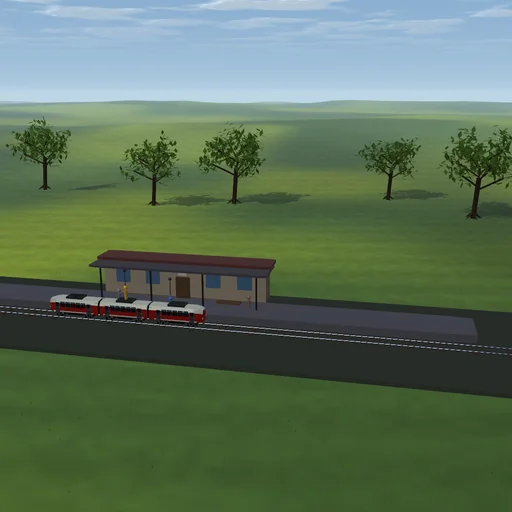
What happens
The Einstein train, staged for real: lightning hits both ends of a moving train, the light fronts expand as circles at c, and the platform observer M catches both flashes together while M′ in the train's centre meets the front flash first. Tick "ride the train" and the SAME two strikes are drawn in the train's frame: the carriages rest at full length, the platform streams backward contracted, the strikes are no longer simultaneous - and the fronts are still circles at c, which is the whole postulate. Drag the frame velocity and the Minkowski grid shears live: the train worldlines tilt, and the two lightning strikes - simultaneous on the platform - split apart by exactly v·L₀ in the train frame. On the clock bench a resting and a flying light clock race photons between mirrors; the traveller draws the visibly longer zigzag and its counter falls behind by exactly γ. Then let the muon rain fall: at 0.995c one atom-height in ten survives the 15 km drop - right on exp(−h/γvτ) - where a lifetime without dilation would deliver one in ten billion. Tick the checkbox to ride along and watch the mountain contract instead.
Equations used in the module
Equations
β = v/c; γ = 1/√(1−β²)
t′ = γ(t−vx/c²); x′ = γ(x−vt)
L = L₀/γ; Δt = γΔt₀
w = (u+v)/(1+uv/c²)