Engineering
Compressed-air storage
Charge the vessels with a compressor and run the air back out through an expander. Throw the heat of compression away in a cooler, keep it in a rock store or leave it in the air, hold the charge for hours, and compare what each cycle returns.
What happens
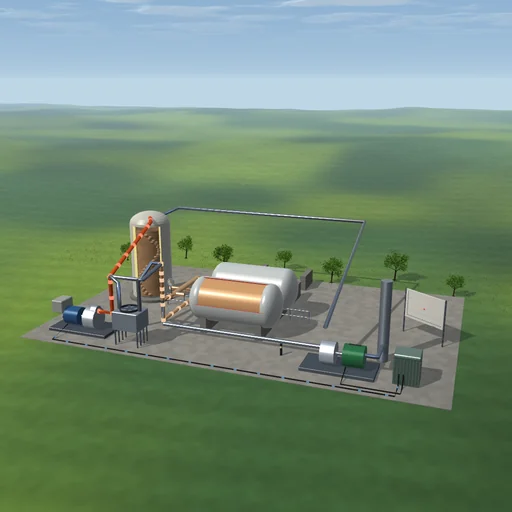
Steel vessels of 25 m³ each hold the air between 4 and 20 bar. A compressor of 85 % isentropic efficiency pushes ambient air in; the higher the pressure it works against, the hotter its outlet – 459 K into 4 bar, 757 K into 20 bar. The hot air goes into the vessel as it is, through an aftercooler that throws its heat away, or through a rock store that keeps it. On the way out an expander lets the air down from the vessel’s pressure to the atmosphere and drives a generator; with the store the air first takes the heat back. The vessel’s wall trades heat with the outside, 150 W/K.
One cycle of 50 m³ from 4 to 20 bar and back at 1 kg/s: keeping the heat in the air returns 65.1 % of the electricity, but only while the air is hot – held for two hours it returns 23.7 %. The aftercooler throws the heat away at once: 34.9 %. The rock store gives back 52.6 %, and 35.2 % after two hours. Expanded from the ambient temperature, the air would leave far below freezing: from 20 °C at 20 bar the exhaust is at 150 K.
Model: an ideal gas with constant specific heats in one well-mixed vessel, the first law of an open system for its mass and internal energy; compressor and expander as single adiabatic stages; heat exchangers of effectiveness 0.9; the store one heat capacity of 0.5 MJ/K with a small loss; RK4 at 1 s.
Try this
Run one cycle with each way of handling the heat and compare the round trips. Then hold the charge a few hours: the hot air cools, and its heat takes energy with it.
Equations used in the module
Equations
T_c = T_a·(1 + (π^((γ−1)/γ) − 1)/η_c)
d(m·u)/dt = q_in·h_in − q_out·h + UA·(T_a − T)
p·V = m·R·T
P_e = η_g·q·c_p·(T_in − T_out)