Engineering
District heating network
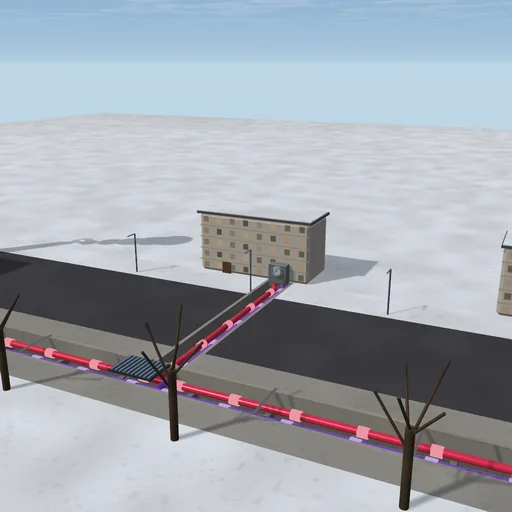
Heat three blocks of flats from one boiler through the street’s mains. The far block gets the least water and the coolest; throttle the near block, raise the supply temperature or let thermostats balance the network, and watch what the pipes lose on a frosty day.
What happens
A boiler house heats water to 75 °C, and a pump drives it along the street through a supply main, laid in a channel under the pavement, to the substations of three blocks of flats and back through a return main. Every pipe, valve and radiator resists the flow as Δp = K·q·|q| (q is the mass flow), so the network reduces exactly like a ladder: branches side by side add their conductances 1/sqrt(K), lengths one after another add their K, and the pump’s curve meets the network’s. The far block has the longest way and gets the least water. Heat moves with the water: along a pipe its temperature relaxes towards the ground’s 8 °C as e^(−U·L/(q·c)), in a block’s radiators towards the room’s as e^(−UA/(q·c)), and each block is one heat capacity losing UA·(T_i − T_out) through its walls.
With every valve open the pump sends 2.81 kg/s: 1.08 to the near block, 0.90 to the middle one and 0.84 to the far one. At −10 °C outside, with aged insulation and a supply of 75 °C, the blocks settle at 22.1, 20.6 and 19.3 °C; the pipes lose 33.0 kW of the boiler’s 386 kW, and the water comes back at 42.3 °C. Throttling the near block’s valve to half sends more water down the street: 19.1, 21.2 and 20.0 °C. Poor insulation loses 78.0 kW and leaves the far block at 17.4 °C; good insulation loses 14.0 kW.
Model: steady hydraulics and heat transport at every instant – the water crosses the street in minutes, the blocks change over days; quadratic resistances; exponential cooling along the pipes and in the radiators; one heat capacity per block with 5 kW of internal gains; the boiler limited to 450 kW; RK4 in steps of a minute.
Try this
Let a day pass and read the far block: it is cooler than the near one. Throttle the near valve or switch on the thermostats, then try poor insulation on a frosty night.
Equations used in the module
Equations
Δp = K·q·|q|,  K_par = (Σ K_i^(−1/2))^(−2)
T(L) = T_g + (T₀ − T_g)·e^(−U·L/(q·c))
Q_rad = q·c·(T_s − T_i)·(1 − e^(−UA/(q·c)))
C·dT_i/dt = Q_rad − UA_w·(T_i − T_out) + Q_gain