Physics
Hourglass · 3D
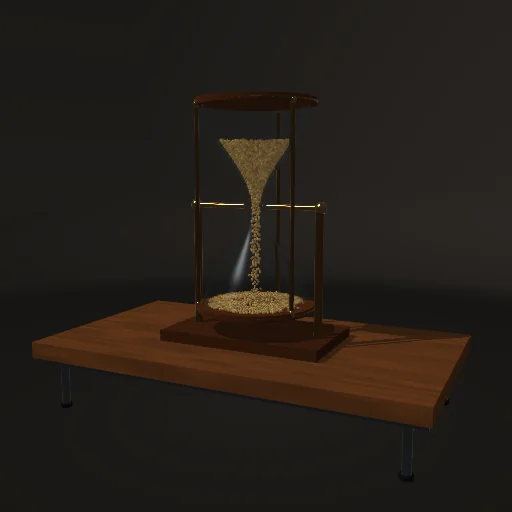
A 3D glass hourglass with thousands of colliding, rotating grains. Change the neck and friction, turn the vessel and measure the flow of sand.
What happens
A 3D glass hourglass with thousands of colliding, rotating grains. Change the neck and friction, turn the vessel and measure the flow of sand. Spherical grains translate and spin, with inelastic contacts, friction and rolling resistance in a closed vessel. This is an educational model of enlarged dry grains with a finite contact iteration count, without air, adhesion or deformation. Beverloo coefficients are illustrative and are not calibrated to real sand. Flow measurement resumes when the turn finishes.
Try this
Orbit with the right mouse button; zoom with the wheel. Turn the complete glass vessel and watch the grains respond to its moving walls. The 3D Beverloo curve is an empirical comparison, not the driver of the simulation.
Equations used in the module
Equations
m v′ = m g + contact impulses; I = 2mr²/5
|Jt| ≤ μ Jn; e = 0.08
Q3D ≈ C φ √g (D − k d)^(5/2) / (πd³/6)
C = 0.58; φ = 0.60; k = 1.5
Fixed Δt = 1/240 s; moving walls transfer momentum