Astronomy / Earth
Planetary energy balance
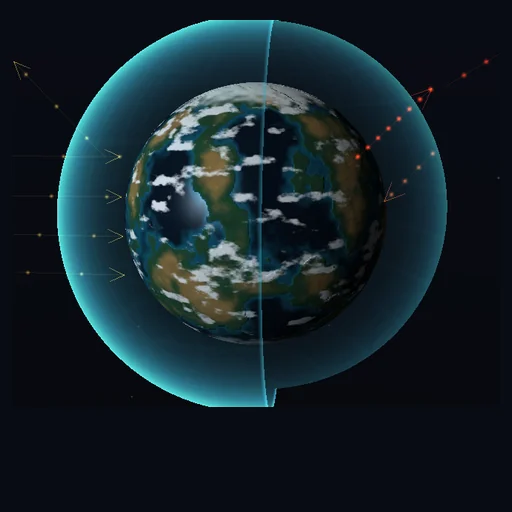
A 3D planet, sunlight and infrared paths, and a measurable energy budget. Change the atmosphere and follow surface warming or cooling.
What happens
Global mean grey radiation model. The surface stores heat; layers equilibrate instantly. No convection, weather, CO₂ spectrum or feedbacks. All fluxes refer to one square metre of the whole planetary surface; incoming sunlight is S/4. Worlds and clouds are procedural illustrations, not maps or weather data. Shell spacing, rotation and moving energy markers are schematic; layers are not altitude bands. Planet selection restores its distance and albedo. Parameter edits begin a new history at the current temperature; pause is preserved.
The model and its limits
Global mean grey radiation model. The surface stores heat; layers equilibrate instantly. No convection, weather, CO₂ spectrum or feedbacks. All fluxes refer to one square metre of the whole planetary surface; incoming sunlight is S/4.
Equations used in the module
Equations
solar constant at distance d: S = L_Sun/(4 pi d^2);  absorbed per unit surface: F = S(1 − A)/4
no atmosphere: sigma T_eq^4 = F, so T_eq = [S(1 − A)/(4 sigma)]^(1/4) - this is the EFFECTIVE temperature, not the surface one
N grey layers, transparent to sunlight, emissivity eps in the infrared:
  U_i = (1 − eps)U_(i−1) + eps sigma T_i^4;   D_i = (1 − eps)D_(i+1) + eps sigma T_i^4
  layer balance: 2 sigma T_i^4 = U_(i−1) + D_(i+1);   surface: sigma T_s^4 = F + D_1;   top: U_N = F
exact families the solver is checked against: eps = 1 gives T_s = T_eq(N+1)^(1/4) and layer j from the top T = T_eq·j^(1/4)
N = 1 and any eps gives T_s = T_eq/(1 − eps/2)^(1/4);  a layer radiates BOTH ways, which is the whole greenhouse
Venus: S is 1.913 times Earth's and T_eq is LOWER - 227 K against 254 - because albedo 0.77 against 0.306
where the model stops: eps = 0.79 reproduces Earth's observed 288 K, and 0.01 of eps is 0.6 K - one fitted knob, no forecast