Engineering
Tidal lagoon
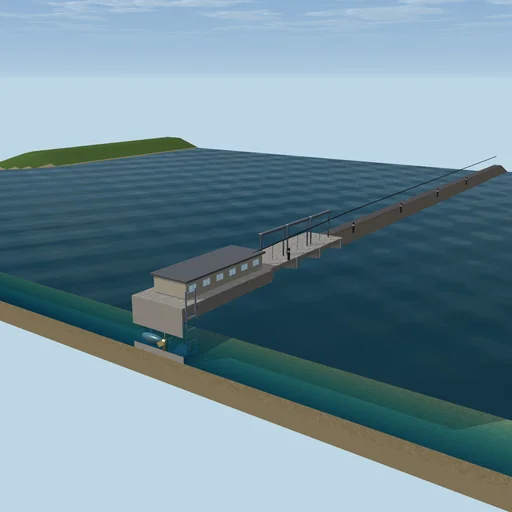
Hold the tide back behind the lagoon’s wall, then let it through the turbines. Generate on the ebb or both ways, choose the head to start at, or work the sluices and the turbines yourself, and compare the energy each tide gives.
What happens
A wall closes off 10 km² of sea. The sea rises and falls 3 m either side of its mean every 12 h 25 min; the basin’s level changes only through the wall – through sluice gates of 1500 m² and through eight bulb turbines of 7 m, each an opening that passes Q = C·A·sqrt(2g·Δh). The operator keeps the gates shut while the tide builds a head between the sea and the basin, then lets the water through the turbines, which turn ρg·Q·Δh into electricity at 88 % and are held to 20 MW each. Ebb generation fills the basin through the sluices while the tide rises and generates while it falls; two-way generation uses both.
Ebb generation that starts at a head of 3 m gives 311 MWh a tide; two-way generation 409 MWh; ebb generation starting at 2 m gives 283 MWh, at 4 m 328 MWh. A basin filled at high water and emptied at low water would hold ρg·A·(2a)²/2 = 503 MWh: waiting for the head costs head, and generating takes time.
Model: the basin is one level over a fixed area, A·dh/dt = Q; the flows are orifice flows smoothed over the last 5 cm of head; one harmonic tide; RK4 in steps of 10 s. No waves, no inertia of the water in the ducts, no change of the turbines’ efficiency with the head.
Try this
Watch a whole tide with ebb generation: the basin fills, holds and generates as the sea falls away. Switch to two-way generation and compare the energy of the last tide.
Equations used in the module
Equations
η_s = a·cos(2πt/T)
A·dh/dt = Q_s + Q_t
Q = C·A·sqrt(2g·|Δh|)·sign Δh
P = η·ρg·Q_t·Δh ≤ 8 × 20 MW