Engineering
Pumped storage plant
Pump water up the mountain at night and run it back through the turbine by day. Watch the levels and the head, and find what the round trip returns: the penstock’s friction and the machines’ efficiencies take their share both ways, more at a larger flow.
What happens
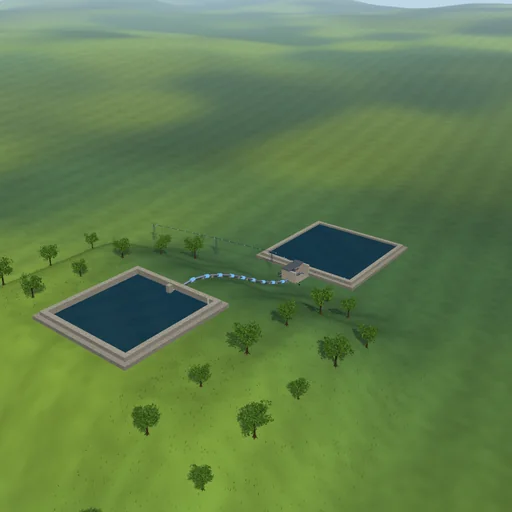
An upper reservoir of 2·10⁵ m² sits 300 m above a lower one of 3·10⁵ m²; a penstock 1500 m long and 5 m across joins them to a reversible pump-turbine with its motor-generator. Pumping lifts the water against the head and the penstock’s loss h_f = (f·L/D + K)·Q²/(2g·A²), so the grid pays ρg·Q·(H + h_f)/(η_p·η_m); generating, the water falls through H − h_f and the grid gets η_t·η_g·ρg·Q·(H − h_f). The levels follow the volume moved, so the head grows as the upper reservoir fills.
At the start the head is 281.7 m, and at 100 m³/s the penstock loses 8.7 m of it. Moving 2.1 million m³ up and back at 100 m³/s takes 1.91 GWh from the grid and returns 1.46 GWh: a round trip of 76.5 %. At 50 m³/s the penstock loses a quarter as much head and the round trip rises to 80.0 %; at 150 m³/s it falls to 70.9 %. No cycle can beat the product of the four efficiencies, 81.2 %. With the upper reservoir 200 m lower the same friction weighs more: 66.9 %.
Model: two reservoirs of fixed area, incompressible water and a quasi-steady flow in the penstock (no water hammer, no surge tank); the flow ramps at 1 m³/s each second through zero when the mode changes; constant efficiencies; RK4, the step split where a ramp ends.
Try this
Let the cycle pump and generate once, then read the round trip. Run it again at 50 and at 150 m³/s, or raise the friction factor, and see where the energy goes.
Equations used in the module
Equations
H = z_u − z_l,  h_f = (f·L/D + K)·Q²/(2g·A²)
P_pump = ρg·Q·(H + h_f)/(η_p·η_m)
P_gen = η_t·η_g·ρg·Q·(H − h_f)
A_u·dz_u/dt = Q = −A_l·dz_l/dt