MakarovSuites
English
EnglishDeutschРусскийУкраїнськаFrançaisEspañolItalianoPolski
Contact & licences

Astronomy

Avoiding an orbital collision

Watch a predicted conjunction and make an avoidance burn. Measure the actual closest approach and compare it with an unpowered pass.
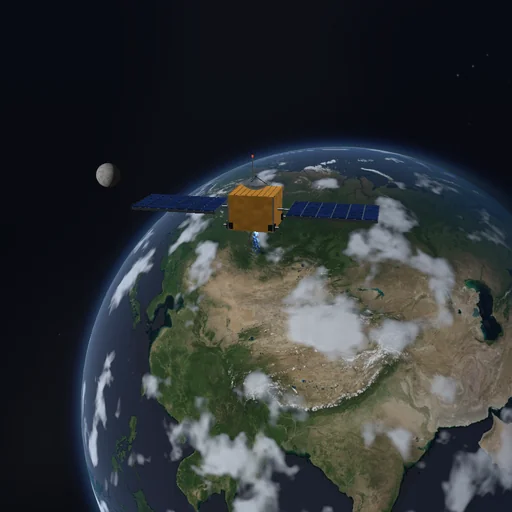
Avoiding an orbital collision — Actual application image
Actual application image

The model and its limits

A conjunction at the real scale: the debris crosses on a straight relative line at kilometres per second, the satellite follows Hill’s equations under bounded thrust with finite propellant. One second of play is one minute of flight. The miss distance is deterministic, not a probabilistic collision risk; orbit uncertainty and manoeuvre planning are omitted. The display compresses the range logarithmically; the encounter holds its result after 55 minutes.

Equations used in the module
Equations
x_ddot = 3 n² x + 2 n z_dot + a_x; y_ddot = -n² y + a_y; z_ddot = -2 n x_dot + a_z; d_min = min |r_1-r_2|
Related experiments

Back to catalogue
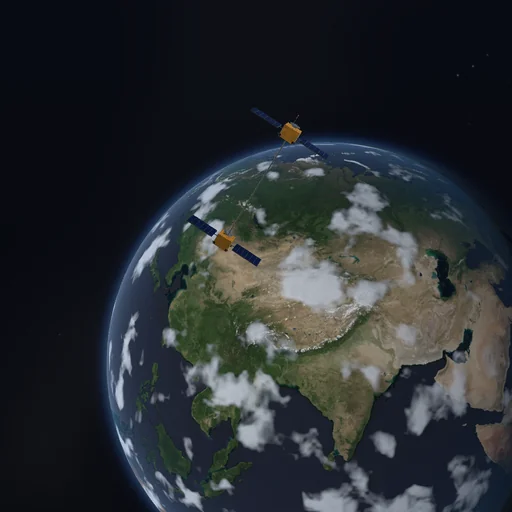
Two spacecraft on a tether — Actual application image

Astronomy

Two spacecraft on a tether

Deploy a tether between two spacecraft. Watch gravity-gradient libration and see how reeling changes the angular motion and tension.

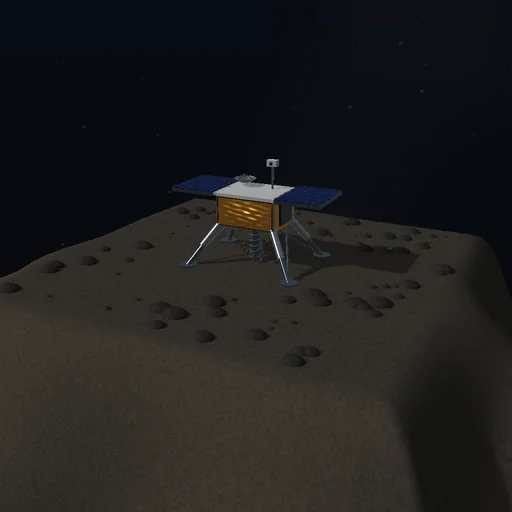
Working on a tiny world — Actual application image

Astronomy / Engineering

Working on a tiny world

Operate a drill where gravity is extremely weak. Anchor the machine before drilling, then release it and see the reaction push the rig away.

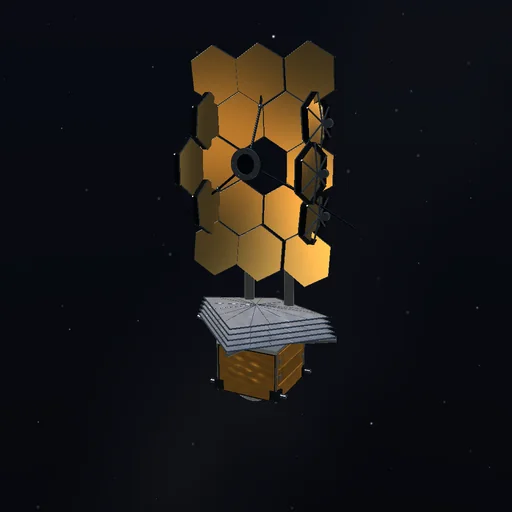
Unfolding a space observatory — Actual application image

Astronomy

Unfolding a space observatory

Unfold a space observatory in a safe sequence. Deploy the shield, raise the mast and open the mirror wings, then align the segments to concentrate starlight.