Physics
Bell test (CHSH)
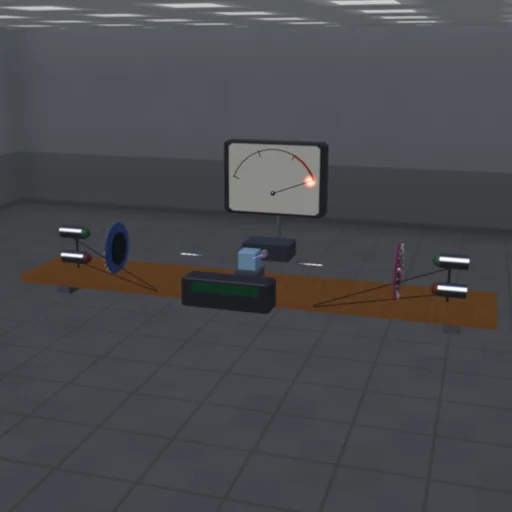
S = 2√2 against the classical bound of 2 - accumulated from sampled ±1 outcomes, not evaluated from a formula. Switch the source to local hidden variables and watch the same bench stall at 2.
What happens
S is not evaluated here, it is accumulated: a pair of settings is drawn at random, two ±1 outcomes come out, and the four correlations are built from counts until the bar climbs past the classical bound of 2 towards 2√2. It stays undefined until all four setting combinations have been sampled - a partial S is an average over settings never tried, and reporting one would be the module's own loophole. Then switch the source to local hidden variables: a shared λ is drawn at the source and each side answers using its own angle alone, and every one of the six strategies stalls at 2.
Equations used in the module
Equations
E(a, b) = −cos(2(a − b))   (singlet)
S = E(a,b) − E(a,b′) + E(a′,b) + E(a′,b′)
classical |S| ≤ 2,   quantum S = 2√2 = 2.828
the curves:  quantum E(Δ) = −cos 2Δ;  the best local model is piecewise linear, −1 + 4|Δ|/π on 0 … π/2 - it touches the cosine at 0, 45° and 90° and lies above it between, where S is taken