Engineering
Belt drive and slip
Raise the load until the belt slips, then add the tensioner and compare. The limit comes from the wrap angle and friction; while the belt slips, the work goes into heat.
What happens
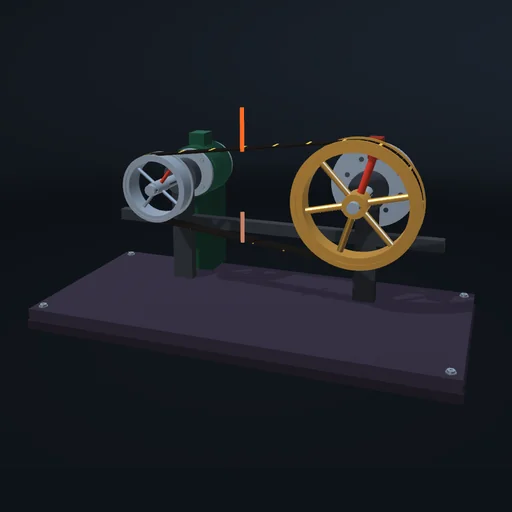
A flat belt runs over a small driving pulley and a larger driven one, which a brake loads. The belt transmits the difference of its span tensions, F = T₁ − T₂, and only up to the Euler–Eytelwein limit T₁/T₂ = e^(μθ), set by the friction coefficient μ and the wrap angle θ on the small pulley. Raise the brake torque: the belt sticks while the force it must carry is below the limit, then it slips, and the slip work warms the belt. With fixed centres the spans share the preload, T₁ + T₂ = 2T₀. A spring tensioner on the slack span holds T₂ = T₀ instead and adds wrap, so the same preload carries more before slipping. Compare both with the same μ and T₀.
Model: rigid pulleys; the belt is one friction coupling between the pulley rims with the Euler–Eytelwein limit, sticking or slipping; no belt stretch (creep), centrifugal tension or span vibration. The slip heat goes into a lumped heat capacity that cools to the air.
Try this
Raise the brake torque until the belt slips; then switch the tensioner on and repeat with the same preload.
Equations used in the module
Equations
T₁/T₂ ≤ e^(μθ)
F = T₁ − T₂
T₁ + T₂ = 2T₀  ⇒  Fmax = 2T₀ (e^(μθ) − 1)/(e^(μθ) + 1)
T₂ = T₀  ⇒  Fmax = T₀ (e^(μθ) − 1)
Q = ∫ F·Δv dt