Engineering
Friction variator
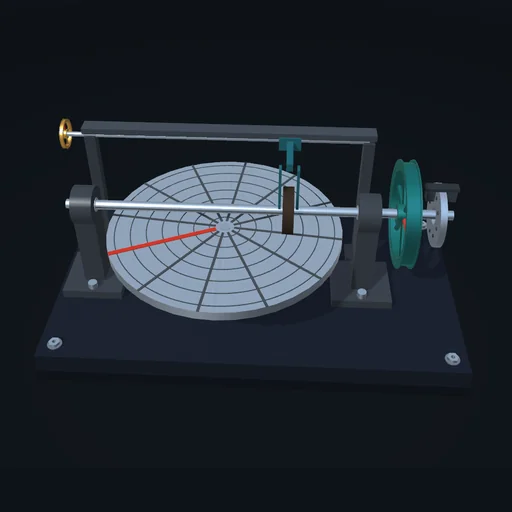
Shift the roller across the turning disc under a steady load: the output speed follows r/R through zero into reverse. Lower the press until the roller slides; then release the press and apply it again on the running disc, and compare the heat of the slip with the energy the flywheel takes up.
What happens
A motor turns a flat disc; a roller of radius R = 0.15 m, pressed on its face with the force N, rides at the distance r from the disc’s axis and drives the output shaft with a flywheel and a load brake. Rolling without slip, the two surfaces move together at the contact, r·ω₁ = R·ω₂: the output turns r/R of the disc, and the ratio follows the roller continuously – through zero at the centre and into reverse beyond it. The contact can pass a tangential force up to μN. A load torque T needs T/R at the roller, wherever it rides; the motor then gives T·r/R. Lower the press below T/(μR), and the roller slides: the output stops, and the motor’s work at the contact turns into heat, μN·r·ω₁. Release the press and apply it again on the running disc: the roller slides while μN spins the flywheel up, and without load the slip heat equals exactly the kinetic energy the flywheel gains.
Model: rigid disc, roller and flywheel; the contact is a point with Coulomb friction that rolls or slides. The roller is shifted at 0.1 m/s; the side slip and the force of shifting, elastic creep, spin across the contact width and wear are not modelled.
Try this
Move the roller slowly from the rim through the centre; then lower the press until the roller slides, and release and apply the press again.
Equations used in the module
Equations
r ω₁ = R ω₂,  F ≤ μN
T₁ = T₂ r/R
N < T₂/(μR)  ⇒  P = μN (r ω₁ − R ω₂)
dω₁/dt = 0,  T₂ = 0  ⇒  Q = ½ J ω₂²