Engineering
Rack and pinion
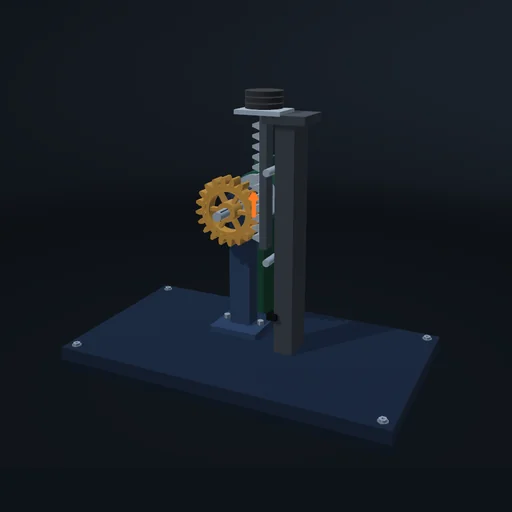
Lift a load with a vertical rack, then reverse the drive; turn the rack horizontal and reverse again. A hanging weight keeps one flank closed, a carriage on a rubbing guide has to cross the play first.
What happens
A pinion turning in a fixed bearing moves a rack along a guide: x = r·θ, and the tooth force is F = T/r. In the vertical layout the rack lifts a load; in the horizontal layout it pushes a carriage along a guide with dry friction. The teeth have a backlash j: inside the play the pair is slack and the pinion pushes only on the flank it reaches. Reverse the drive. The hanging weight keeps the same flank loaded, so the rack follows at once, now lowering the load. The carriage stops instead, the pinion crosses the play on its own, and only then does the other flank take hold: the slack time grows with the backlash. The rack runs between end stops, where the motor stalls at its torque limit.
Model: rigid pinion and rack; two one-sided flank contacts separated by the backlash; Coulomb friction on the horizontal guide; inelastic contacts, no tooth bending. The motor holds its speed up to its torque limit.
Try this
Reverse the drive in both layouts: the hanging load keeps the play closed, the carriage has to cross it first.
Equations used in the module
Equations
x = r·θ,  F = T/r
|x − r·θ| < j/2  ⇒  F = 0
W = ∫ T·ω dt