Engineering
Universal joint
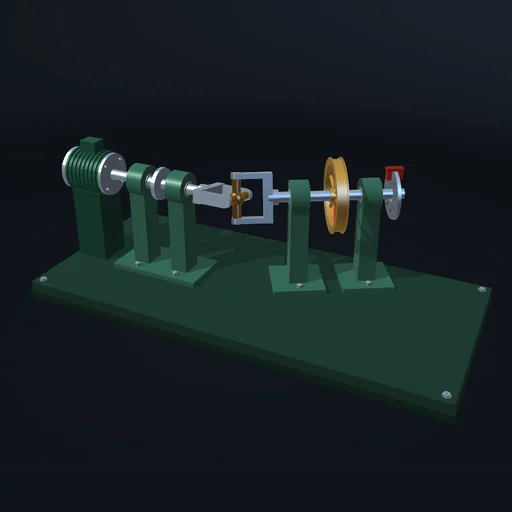
Bend the shaft and watch the output run unevenly at a steady input; add a second joint in phase to cancel it, or crossed to double it. Yokes and crosses are bodies on revolute joints.
What happens
A Cardan (Hooke) joint connects two shafts at a bend angle β through a cross held in two yokes. The motor turns the input steadily; the output keeps the same average speed but speeds up and slows down twice per turn: tan θ₂ = cos β · tan θ₁, so ω₂/ω₁ swings between cos β and 1/cos β. Raise β and watch the swing grow; the flywheel on the output makes the motor push and pull to force the uneven motion on it, so a heavier flywheel shows a larger torque ripple. Two joints with an intermediate shaft cancel the unevenness when their yokes are in phase and the bends are equal, as here, and double it when the yokes are crossed: the ratio then swings between cos²β and 1/cos²β.
Model: rigid shafts, yokes and crosses joined by ideal revolute joints, the shafts in fixed bearings; nothing prescribes the speed law, it comes from the closed chain of joints. No friction or clearance in the joints; the motor holds its speed up to its torque limit, the load is a brake.
Try this
Bend the shaft at a steady input speed and watch the speed ratio swing; then compare the two double arrangements.
Equations used in the module
Equations
tan θ₂ = cos β · tan θ₁
ω₂/ω₁ = cos β / (1 − sin²β · sin²θ₁)
cos β ≤ ω₂/ω₁ ≤ 1/cos β