Engineering
Constant-velocity joint
Bend the drive line and watch the output speed: through the Rzeppa joint it stays exactly that of the input, through a Cardan cross it swings between cos β and 1/cos β of it twice a turn. Watch the balls: the cage keeps them in the plane that halves the bend.
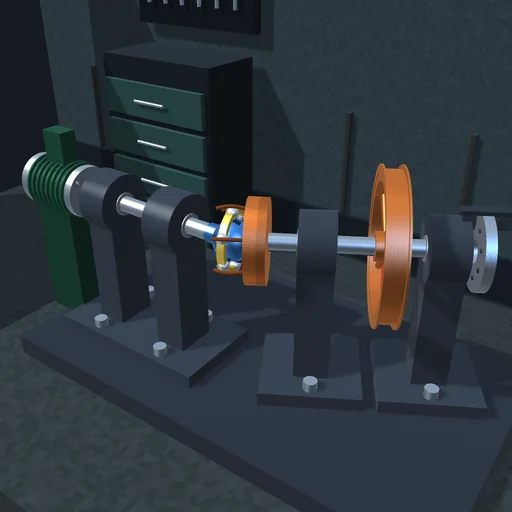
What happens
A motor drives the input shaft; the output shaft, bent by β, turns a flywheel against a brake. In the Rzeppa joint six balls ride in grooves of the inner race on the input and of the outer race on the output, on a sphere about the joint’s centre, and the cage holds them in the plane that halves the bend. A ball there is the same distance from both axes, so it moves both shafts alike: the output turns exactly with the input, at any bend and under load, and the brake’s torque reaches the motor whole. Each ball runs back and forth along its grooves by ±β/2 a turn, ±15° at a bend of 30°.
The single Cardan joint is a cross on two pins. Its output follows tan φ₂ = cos β·tan φ₁ and runs ahead and behind twice a turn: at 30° between 0.866 and 1.155 of the input’s speed, which jolts a load with any inertia. Over a turn both joints pass on the same average speed; the motor’s work goes into the brake’s heat and the flywheel’s energy.
Model: rigid shafts, balls and cross; each ball is held by four rows - its two grooves, the sphere and the cage’s plane - solved together every step. No friction in the grooves or pins.
Try this
Bend the line to 30° and compare the Rzeppa joint with the Cardan cross: watch the speed ratio and the output’s chart.
Equations used in the module
Equations
Rzeppa: ω₂ = ω₁  (balls in the bisecting plane)
Cardan: tan φ₂ = cos β·tan φ₁
ω₂/ω₁ = cos β/(1 − sin²β·cos²φ₁)
cos β ≤ ω₂/ω₁ ≤ 1/cos β