Engineering
Clock escapement
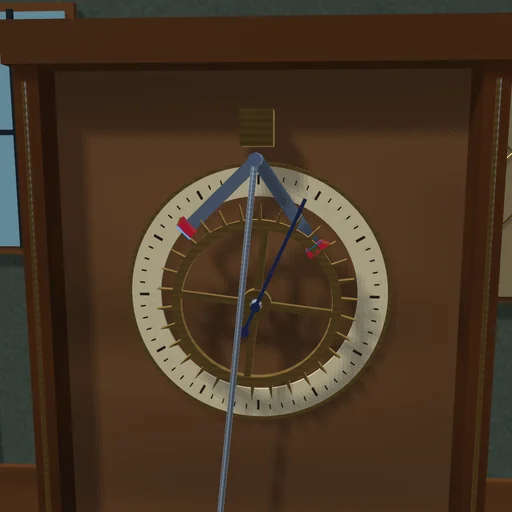
A seconds pendulum and the escape wheel of a clock meet only where the teeth touch the anchor’s pallets: a tooth rests on a locking face, the swing slides it off, it pushes the impulse face and drops onto the other pallet. Change the drive and watch the swing settle anew; hold the pendulum and see whether the clock starts again.
What happens
A Graham dead-beat escapement. The escape wheel of 30 teeth is turned by a steady torque - the weight’s, through the train - and carries the seconds hand: it turns once a minute. The anchor swings with the pendulum, a 1.5 kg bob 0.99 m below the pin, whose free swing takes 2 s. Each pallet’s locking face is an arc about the pin: a tooth resting on it stops the wheel dead and pushes the pendulum neither way. Near the bottom of the swing the corner slides out from under the tooth; the tooth pushes the inclined impulse face over 2.5° of the swing, drops off, and the wheel turns until the other pallet catches the next tooth on its locking face, some 2.4° past the corner. Two beats a period, one tooth a period - and never back.
A damper takes the swing away; the impulses pay it back, and the swing settles where they balance: 5.70° for 0.06 N·m, 7.34° for 0.1 N·m. Each beat gives the pendulum 4.9 mJ of the 6.3 mJ the wheel’s torque does; the rest is lost where the wheel lands on a pallet. The impulses come just after the bottom and lengthen the period to 2.006 s: a clock beating seconds with it would lose 4 minutes a day. Hold the pendulum near a turning point and let go: it starts again; hold it near the middle and the clock stops.
Model: rigid wheel and pendulum on pins; the teeth’s tips touch the pallets’ outlines through one-sided contacts and nothing else couples them. No friction; the damper is a torque proportional to the swing’s speed.
Try this
Raise the drive torque and watch the swing settle wider. Hold the pendulum near the middle for a moment and let go.
Equations used in the module
Equations
T₀ = 2π·√(I/(m·g·L))
T(A) = (2/π)·T₀·K(sin²(A/2))
W_drive = τ·2π/z  per period
τ·2π/z = W_damper + W_landings  (steady swing)