Engineering
Four-bar linkage
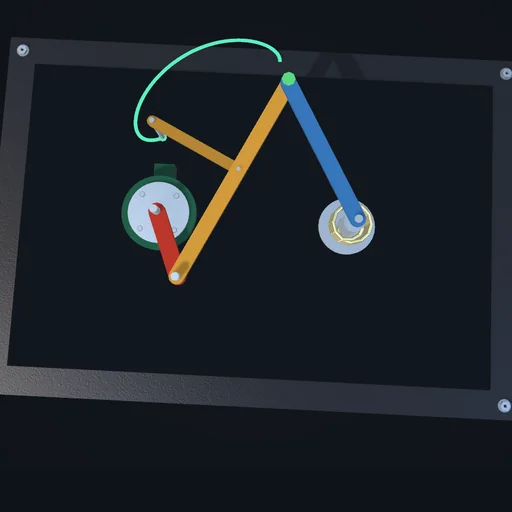
Switch between a crank-rocker, a drag link and a triple rocker and watch the transmission angle: near a dead point the drive labours, and the triple rocker stalls and turns back. The coupler draws its curve on the plate.
What happens
Four links joined by four pins: a fixed frame d, a crank a driven by a motor, a coupler b and an output link c, which a spring and a damper hold. Grashof's rule tells what they can do: if the shortest plus the longest link are no longer than the other two together, s + l ≤ p + q, the shortest link can turn fully. Crank-rocker: the crank turns, the output rocks. Drag link: the frame is the shortest link, so both cranks turn, the output unevenly. Triple rocker: no link turns fully; at a toggle position the drive stalls and the motor turns back. The transmission angle μ between coupler and output shows how well the coupler pushes: near 0° or 180° most of the force only loads the pins, and the motor torque peaks. A point on the coupler draws its curve on the plate.
Model: rigid links and ideal revolute joints in one plane; the motor holds its speed up to its torque limit and reverses when it stalls; a linear spring and a viscous damper on the output pivot. No friction or clearance in the joints.
Try this
Switch the linkage type and load the output; watch the transmission angle and the motor torque near the dead points.
Equations used in the module
Equations
s + l ≤ p + q
cos μ = (b² + c² − a² − d² + 2ad cos θ) / (2bc)