Engineering
Cam and spring-loaded follower
Compare three smooth lift laws and raise the speed until the roller leaves the cam; then stiffen the spring until contact returns. The contact can only push, so a lift-off is computed, not drawn.
What happens
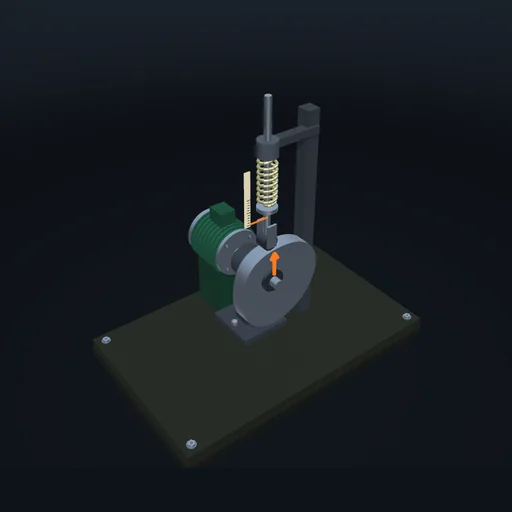
A disc cam turns under a roller follower that a spring presses down. The cam profile comes from a lift program: rise over 140°, dwell of 40° at the top, return over 140°, rest. Three laws give the same lift with different accelerations: harmonic (its acceleration jumps at the start and end of each stroke), cycloidal and the 3-4-5 polynomial. The contact can only push. Where the program asks the follower to slow down faster than the spring and gravity can pull it back, the roller leaves the cam: below the critical speed ωc it stays in contact, above it the roller jumps and lands with a knock. Use the buttons to run just below and just above ωc, then stiffen the spring or add preload and watch the contact return. The largest jump is kept until the next start.
Model: rigid cam and follower; a one-sided contact on the path of the roller centre; a linear spring, an optional viscous damper on the stem, and gravity. The motor holds the cam speed up to its torque limit. No roller slip, contact deformation or bounce.
Try this
Use the two ωc buttons to run either side of the critical speed; then stiffen the spring until the roller stays on the cam.
Equations used in the module
Equations
a = ω²·d²s/dφ²
N = m(a + g) + F₀ + k·y ≥ 0
ωc² = min (F₀ + k·s + m·g) / (−m·d²s/dφ²)