Engineering
Barrel cam
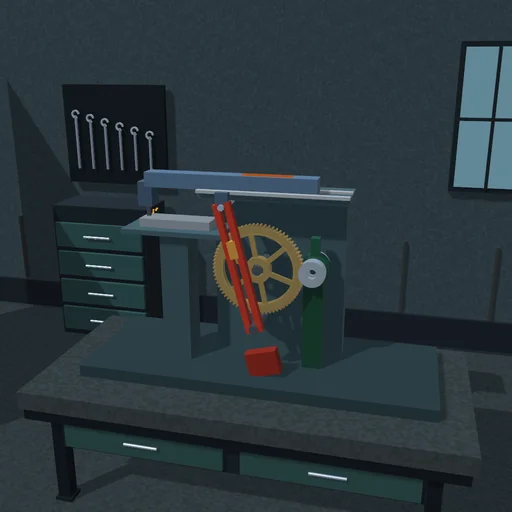
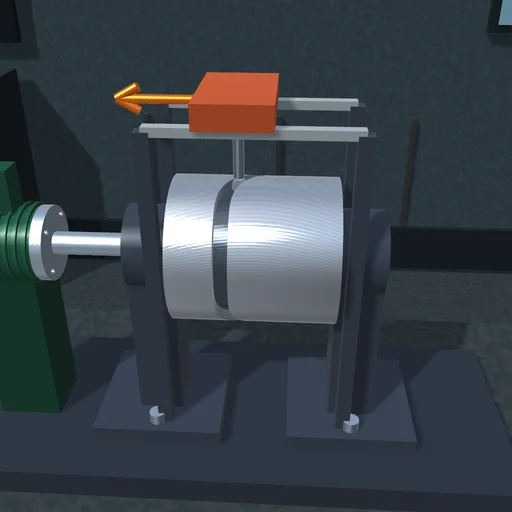
The groove round the drum moves the carriage out, holds it, brings it back and holds it again. Shorten the rise and watch the groove lean steeper and the drum torque climb; give the roller more friction and see the load drive the drum back on the return only while the groove is steep.
What happens
A drum of radius 0.25 m turns about its axis; a groove runs round its surface, and a roller in the groove drives a carriage along rails parallel to the axis. The groove’s program is a cycloidal rise of 0.2 m over the angle β, a dwell, the cycloidal return over β and a second dwell: the carriage starts and stops without a jolt. The groove leans by the pressure angle α, tan α = s′(θ)/R; for β = 120° up to 37.4°, and at 2 rad/s the carriage runs at up to 0.38 m/s.
A steady force F pushes the carriage back against the rise, and the roller slides on the groove’s wall with friction μ. On the rise the drum must push the load up the incline like a screw: F·R·tan(α + φ), 42.3 N·m at mid-rise for 200 N and μ = 0.05. On the return the load drives the drum back with F·R·tan(α − φ) while the groove is steeper than the friction angle; in the dwells the roller only drags, μ·F·R. Over a turn the load’s work cancels, and the motor pays only the groove’s heat: 18 J at μ = 0.05, 110 J at μ = 0.3.
Model: rigid drum and carriage; the groove is one row along its line and one row of Coulomb friction on its wall; a motor with a torque cap holds the drum’s speed. The roller slides rather than rolls; the carriage’s weight rests on its rails.
Try this
Shorten the rise to 90° and watch the pressure angle and the motor torque. Raise μ to 0.3: the return then needs less help, the dwells more.
Equations used in the module
Equations
s = S·(θ/β − sin(2πθ/β)/(2π))
tan α = s′(θ)/R,  φ = atan μ
τ_rise = F·R·tan(α + φ)
τ_return = F·R·tan(φ − α),  τ_dwell = μ·F·R