Engineering
Pantograph
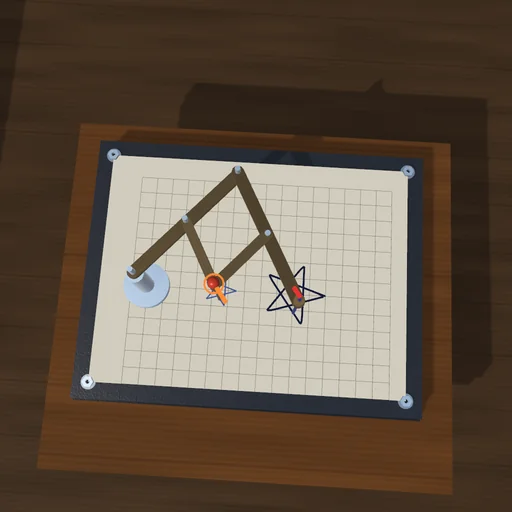
Lead the stylus round a figure and watch the pen draw it two or three times larger. Compare the forces: the hand pushes k times as hard as the pen drags. Switch the hand off and push the stylus with a steady force: below k times the drag nothing moves.
What happens
Bar OB turns about the fixed pivot O and bar BQ about the elbow B, both 0.8 m long. A short bar from A on OB and a bar from C on BQ, each L/k from the joint before it, meet at the stylus P and close the parallelogram A-B-C-P. Whatever the hand does, O, P and the pen Q stay on one line with OQ = k·OP: the pen draws the stylus’s figure k times larger, twice or three times here. The five pins do this alone, nothing compares the two points.
The pen drags on the paper with dry friction D. The bars pass that drag back to the stylus multiplied: moving the stylus a little moves the pen k times as far, so the hand must push k·D - 20 N for a pen that drags with 10 N at k = 2. All the hand’s work ends as the pen’s heat, D times the pen’s path. Switch the hand off and push the stylus with a steady force: under k·D it stays put.
Model: rigid bars on five revolute joints; the hand is a stiff spring with a damper and a force cap that leads the stylus round the figure; the pen is a point with Coulomb friction on the paper. No friction in the pins.
Try this
Trace a star at k = 2 and read the hand and pen forces. Then switch tracing off and raise the push slowly until the pen moves.
Equations used in the module
Equations
Q − O = k·(P − O)
F_hand = k·D  (pen sliding)
W_hand = D·s_pen