Engineering
Peaucellier straight-line linkage
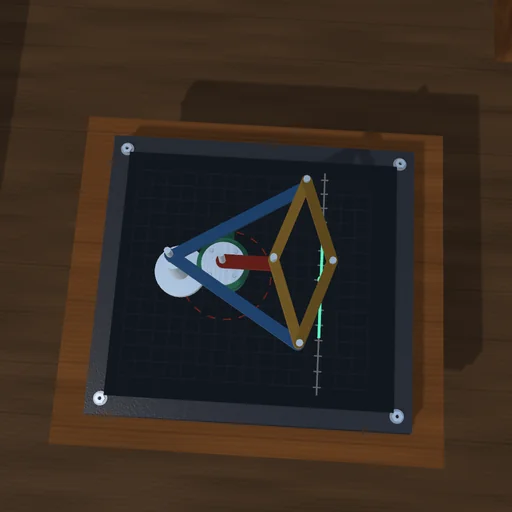
Swing the crank and watch the pen at the far corner of the rhombus run along the ruled line, exactly. Push the pen across the line: the crank feels nothing. Then move the crank’s pivot a centimetre and see the line turn into a large circle.
What happens
Two arms of 0.9 m from the fixed pivot O hold the side corners of a rhombus of side 0.5 m. Its near corner P rides on a crank of 0.3 m whose pivot R stands 0.3 m from O, so P runs on a circle through O. The far corner Q is the inverse of P: O, P and Q stay in line and OP·OQ = l² − s² = 0.56 m², and the inverse of a circle through O is a straight line - here at 0.933 m from O. With the crank at 30° the pen has gone 250 mm along the line, at 60° 539 mm; at 96.4° the rhombus folds flat. Seven bars and ten pins do this; nothing else holds Q on the line.
A force across the line does no work on any motion the linkage allows, so the crank never feels it. One along the line it must hold: 25 N·m at 30° for 50 N. Move the crank’s pivot by 1 cm and P’s circle misses O: the pen now runs on a circle of 27.5 m.
Model: rigid bars on ten revolute joints, solved together every step; a servo with a torque cap drives the crank. No friction or elasticity.
Try this
Swing the crank and read the deviation: none. Push along and across the line and compare the motor torque; then move the pivot 1 cm.
Equations used in the module
Equations
OP·OQ = l² − s² = k
|RP| = |RO| = q  ⇒  u_Q = k/(2q)
v_Q = (k/2q)·tan(β/2)
τ = −F·(k/4q)·sec²(β/2)