Engineering
Scotch yoke
Run a Scotch yoke and a slider-crank from the same crank: equal strokes, but only the yoke moves as a pure cosine. Shorten the connecting rod and watch the difference grow; load the outputs and compare the crank torque.
What happens
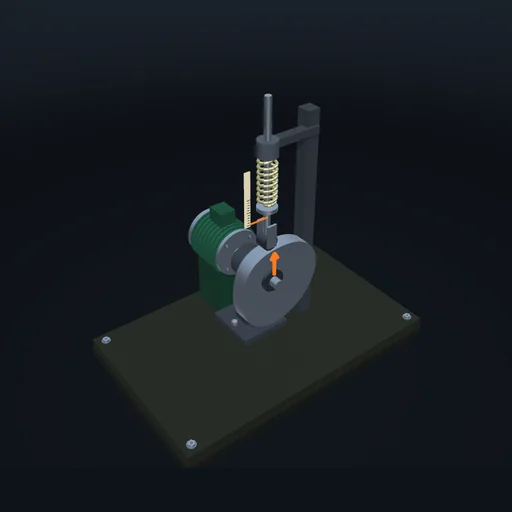
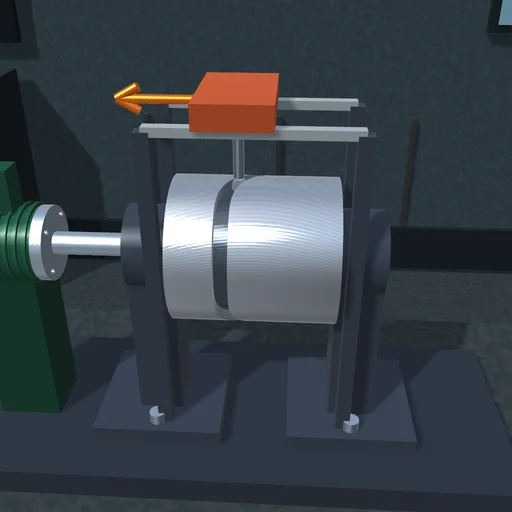
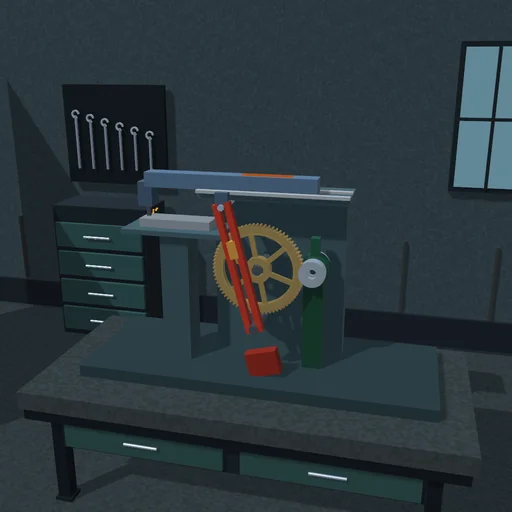
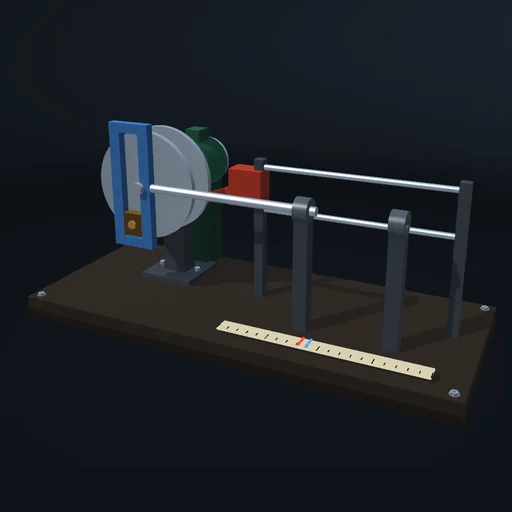
One crankshaft drives two outputs. In front, the crank pin carries a block that slides in a straight slot of the yoke: x₁ = r cos θ, a pure harmonic motion. Behind, the same crank drives a slider through a connecting rod of length l: x₂ = r cos θ + √(l² − r² sin²θ), shifted and distorted by the swing of the rod. Both strokes are 2r. The pointers on the common scale show the two positions, x₂ measured from l; their difference grows as the rod gets shorter compared with the crank. Add rail friction to the yoke or to the slider and compare the crank torque and the side force on the block in the slot.
Model: rigid parts joined by ideal pins and slides; the rail friction is a limited force against the motion; the motor holds its speed up to its torque limit. No clearance or friction in the pins and the slot.
Try this
Compare the two pointers on the common scale, then shorten the connecting rod and repeat.
Equations used in the module
Equations
x₁ = r cos θ
x₂ = r cos θ + √(l² − r² sin²θ)
x₂ − l − x₁ ≈ −r² sin²θ / (2l)