Engineering
Ratchet and pawl
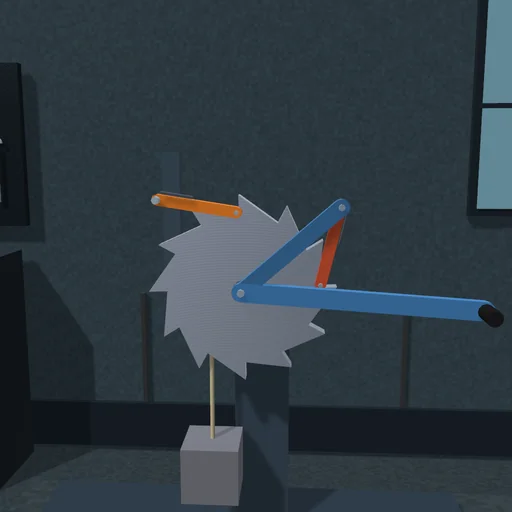
Swing the lever and the load climbs a tooth at a time: the driving pawl pushes a tooth forward, the holding pawl clicks over the teeth and catches the wheel when the lever goes back. Stop the lever: the load stays. Lift the pawls and let it run down, then drop them and watch the blow.
What happens
A ratchet wheel of 12 saw teeth turns on a shaft together with a drum of radius 0.12 m; the rope of a 20 kg load is wound on the drum. A lever on the same shaft carries the driving pawl; the holding pawl hangs from a pin on the frame. Springs press both onto the teeth. On each forward stroke the driving pawl pushes a tooth’s straight face and lifts the load by one tooth, r_d·2π/z = 62.8 mm, against m·g·r_d = 23.5 N·m on the lever, while the holding pawl rides up the backs of the teeth and drops into the next gap. On the return the holding pawl catches a face and keeps the load, and the driving pawl slides back over a tooth. The wheel can turn only one way - not because anything forbids the other, but because a pawl’s tip stands against a face.
Stop the lever: the load stays. Lift both pawls: the load runs down with m·g·r_d²/(I + m·r_d²) = 5.06 m/s², turning the wheel. Drop them back and the holding pawl catches the running wheel with a blow.
Model: rigid wheel, lever, pawls and load; the pawls’ tips touch the teeth’s outline through one-sided contacts, their springs are torques on their pins; a servo with a torque cap swings the lever. No friction.
Try this
Let the lever work and count the teeth. Stop it, then lift the pawls for a moment and drop them: read the blow.
Equations used in the module
Equations
Δh = r_d·2π/z  per stroke
τ = m·g·r_d
a = m·g·r_d²/(I + m·r_d²)  (pawls lifted)
W_lever = m·g·Δh + losses